TL;DR
Learn how to effectively orchestrate and scale Docker containers using Docker Compose, Swarm mode, and advanced scaling techniques.
Docker Orchestration and Scaling: A Comprehensive Guide
Executive Summary
Orchestration is what turns a set of containers into a system: it places replicas across hosts, restarts what fails, rolls out new versions without downtime, and routes traffic to healthy instances. This guide covers the tooling that ships with Docker itself: Compose for defining multi-container applications, Swarm mode for clustering and production deployment with the same Compose files, and stacks for managing them as a unit. It explains scaling, update and restart policies, placement constraints, load balancing, and service discovery, and it is explicit about where Docker's built-in orchestration stops being enough and Kubernetes becomes the honest answer.
Why This Matters
Running containers by hand works until the first host failure, the first deployment that must not drop requests, or the first service that needs six replicas spread across machines. At that point, whoever is on call becomes the orchestrator, restarting containers and rebalancing traffic manually during incidents. The cost of skipping orchestration is not theoretical: it shows up as downtime during routine deploys, uneven load because nothing spreads replicas, and configuration drift between hosts because each was set up by a slightly different sequence of commands. A declarative stack file plus a scheduler removes those failure modes and makes the running system reproducible from version control.
Core Concepts
Compose: The Unit of Definition
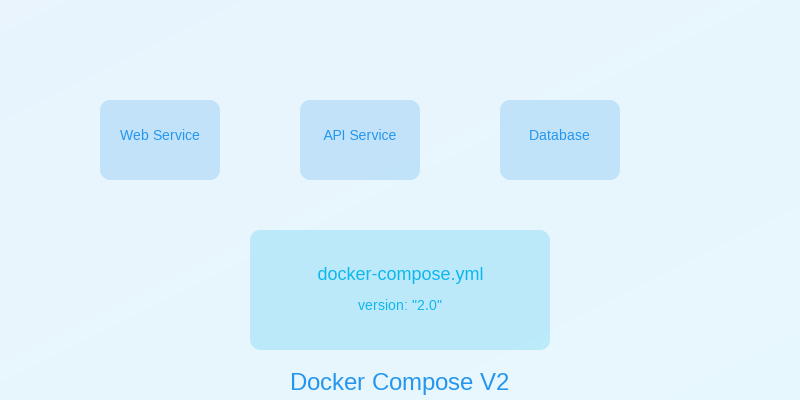
Compose describes services, networks, and volumes in one file. The same file that runs a development stack is, with its deploy section honoured, the input to a Swarm stack. The example below is the shape most real stacks take: a public frontend, an API straddling two networks, and a database reachable only from the backend network with its data on a named volume.
version: '3.8'
services:
  web:
    image: nginx:alpine
    ports:
      - "80:80"
    deploy:
      replicas: 3
      resources:
        limits:
          cpus: '0.5'
          memory: 512M
    networks:
      - frontend

  api:
    build:
      context: ./api
      dockerfile: Dockerfile
    environment:
      - NODE_ENV=production
    depends_on:
      - db
    networks:
      - frontend
      - backend

  db:
    image: postgres:14
    volumes:
      - db_data:/var/lib/postgresql/data
    networks:
      - backend

networks:
  frontend:
  backend:

volumes:
  db_data:
Two cautions belong here. depends_on orders container startup; it does not wait for the database to accept connections, so applications must retry on connect. And resource limits under deploy are ignored by standalone Compose unless you run in Swarm mode, which surprises teams moving a file from a laptop to a server unchanged.
Swarm Mode: The Cluster Layer
Swarm mode is built into the Docker engine. Manager nodes hold the desired state and schedule tasks; worker nodes run them. Managers use a Raft consensus store, so run an odd number of managers and treat manager availability as the availability of your control plane. Services, rather than individual containers, are the scheduling unit: you declare replicas, update behaviour, and placement, and the scheduler reconciles reality with the declaration continuously.
version: '3.8'
services:
  web:
    image: nginx:alpine
    deploy:
      mode: replicated
      replicas: 6
      placement:
        constraints:
          - node.role == worker
      update_config:
        parallelism: 2
        delay: 10s
      restart_policy:
        condition: on-failure
    ports:
      - "80:80"
    networks:
      - overlay_net

networks:
  overlay_net:
    driver: overlay
The update_config is what makes deploys safe: Swarm replaces tasks in batches of parallelism, waits delay between batches, and can roll back on failure. The restart_policy controls when a task is restarted and how aggressively, which prevents a crashing container from spinning in a tight loop.
Scaling and Placement
Scaling in Swarm is changing the replica count; the scheduler starts or stops tasks to match. Placement constraints and preferences decide where those tasks land: keep application replicas off manager nodes, spread them across hosts or zones so one failure cannot take the service down, and cap replicas per node for noisy workloads.
version: '3.8'
services:
  api:
    image: api:latest
    deploy:
      mode: replicated
      replicas: 3
      resources:
        limits:
          cpus: '0.50'
          memory: 512M
      update_config:
        parallelism: 2
        delay: 10s
      restart_policy:
        condition: on-failure
      placement:
        max_replicas_per_node: 1
Swarm does not autoscale on its own. There is no built-in equivalent of a horizontal pod autoscaler; teams either scale manually, script against metrics, or accept that as the trigger to evaluate Kubernetes. Be honest about which of those you are doing.
Load Balancing and Service Discovery
Swarm gives every service a virtual IP and an embedded DNS name. Requests to the service name are load-balanced across healthy tasks by the routing mesh, and published ports are served by every node in the cluster, not just nodes running the task. For HTTP routing by hostname or path, put a reverse proxy such as Traefik in front; it discovers services through the Docker API and reconfigures itself as tasks come and go.
version: '3.8'
services:
  lb:
    image: traefik:v2.9
    command:
      - "--api.insecure=true"
      - "--providers.docker=true"
    ports:
      - "80:80"
      - "8080:8080"
    volumes:
      - /var/run/docker.sock:/var/run/docker.sock
    deploy:
      placement:
        constraints:
          - node.role == manager

  web:
    image: nginx:alpine
    deploy:
      replicas: 3
    labels:
      - "traefik.enable=true"
      - "traefik.http.routers.web.rule=Host(`example.com`)"
The Traefik dashboard flag --api.insecure=true and the mounted Docker socket are development conveniences; in production, restrict the dashboard and understand that socket access is host-level privilege. External service discovery systems such as Consul are occasionally added for cross-cluster or non-container workloads, but inside a single Swarm, the built-in DNS is sufficient and simpler.
High Availability
Availability in Swarm is a property of placement and restart policy, not of any single feature. Spread replicas across nodes and failure zones, restart on failure with a delay and an attempt ceiling, and keep enough manager nodes for quorum while remembering that managers also schedule: an overloaded manager is a cluster-wide problem.
version: '3.8'
services:
  web:
    image: nginx:alpine
    deploy:
      replicas: 6
      placement:
        constraints:
          - node.role == worker
        preferences:
          - spread: node.labels.zone
      restart_policy:
        condition: on-failure
        delay: 5s
        max_attempts: 3
        window: 120s
Monitoring and Logging
An orchestrated system needs cluster-level visibility: metrics from the engine and containers into Prometheus, dashboards in Grafana, and centralised logs with rotation set per service. Without it, the scheduler's self-healing hides failures from you; a task can restart hundreds of times while every dashboard stays green because the replica count never changed.
Decision Framework
| Situation | Recommendation |
|---|---|
| Local development or single-host deployment | Docker Compose; skip Swarm entirely |
| Small production estate, a few hosts, modest services | Swarm mode with stack files, rolling updates, spread placement |
| Need autoscaling on CPU or custom metrics | Kubernetes; Swarm has no built-in autoscaler |
| Need rich scheduling, operators, or a large ecosystem | Kubernetes |
| Mixed container and legacy estate needing one discovery system | Swarm DNS inside the cluster; add Consul only for the cross-boundary cases |
| Stateful primary database | Managed database service, or a single carefully operated instance; do not scale it like a stateless service |
Implementation Checklist
update_config sets batch parallelism and delay so deploys roll rather than replacerestart_policy has a delay and a maximum attempt countTrade-offs
Swarm's strength is that it is already installed and the learning curve from Compose is gentle; its weakness is a smaller ecosystem, no built-in autoscaling, and fewer managed offerings from cloud providers. Compose alone is simpler still but is not a cluster scheduler. Rolling updates protect availability but stretch deployment time and temporarily run two versions, which your application and schema changes must tolerate. Spread placement improves resilience while reducing packing efficiency, so you pay for headroom you hope not to use.
When Not to Use
depends_on as a readiness mechanism: it orders starts only. Applications that cannot retry a database connection will crash-loop on first deploy regardless of orchestration.Conclusion
Compose defines the application, Swarm schedules it, and update, restart, and placement policies determine how it behaves under failure and change. For small estates that combination is genuinely sufficient and refreshingly simple. The discipline that matters is treating the stack file as the system: if a change is not in the file, it does not exist.
Why This Matters
Understanding the business and technical context helps you make informed decisions rather than blindly following patterns.
Trade-offs to Consider
Every architectural decision involves trade-offs. Consider your specific requirements, team expertise, and scale when evaluating options.
When NOT to Use This
Knowing when a solution doesn't apply is as valuable as knowing when it does. Consider alternatives for your specific situation.
Decision Framework
Use this framework to evaluate whether this approach is right for your use case based on your specific constraints and requirements.