10 Best Practices to Secure Your AWS Account from Hackers
Learn essential security practices to protect your AWS account, implement proper IAM policies, and monitor for potential security threats.
Robust AWS Account Security: A Pragmatic Engineering Guide
TL;DR: This guide outlines ten actionable best practices for securing your AWS account against common threats. It focuses on practical implementation across Identity and Access Management (IAM), logging, network security, data protection, monitoring, incident response, compliance, and regular assessments.
Introduction
In the dynamic landscape of cloud computing, robust security is not an afterthought but a foundational requirement. This article provides experienced engineers with a comprehensive framework for hardening AWS accounts, moving beyond superficial checks to implement deep, layered security controls. We will cover essential AWS services and configurations to build a resilient and secure cloud environment.
What You'll Learn
- Critical security measures for the AWS root account.
- Advanced IAM strategies, including least privilege and role-based access.
- Effective logging and monitoring techniques using AWS services.
- Network security principles and their application in AWS.
- Data protection mechanisms for both data at rest and in transit.
- Proactive threat detection and incident response planning.
- Leveraging AWS for compliance and continuous auditing.
- The importance of regular security assessments and their methodologies.
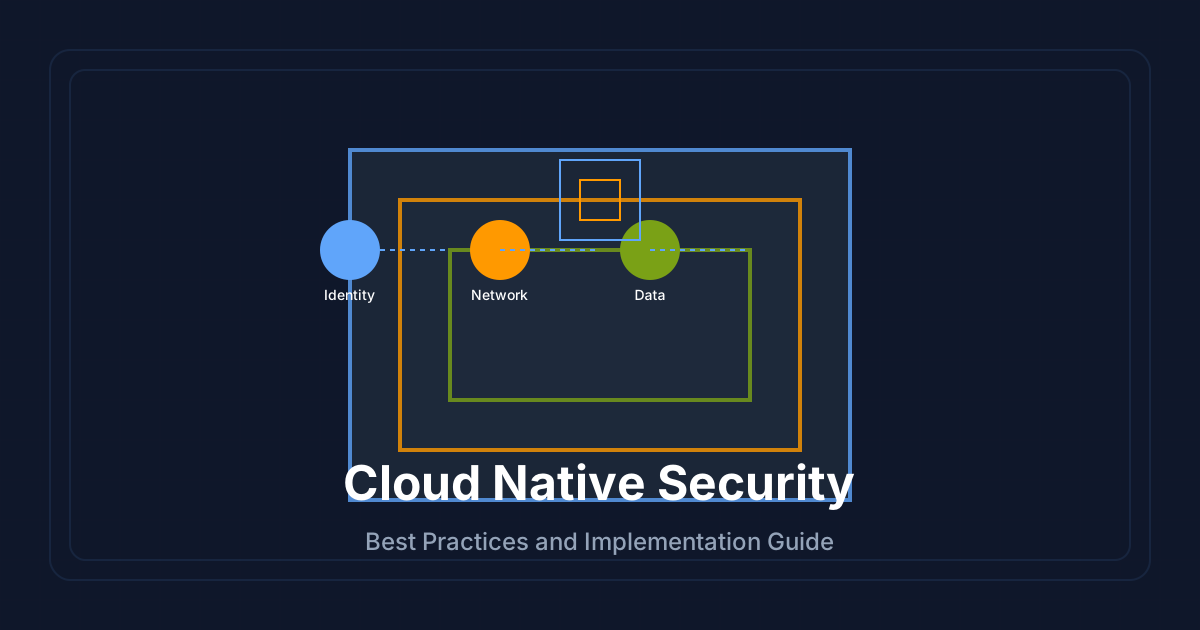
AWS Security Layers
1. Secure Your Root Account
The root account is the most powerful entity in your AWS account. Compromise of the root account grants attackers unrestricted access.
Root Account Hardening Best Practices
| Practice | Implementation Detail | Rationale | | :----------------------- | :----------------------------------------------------------- | :----------------------------------------------------------------------------------------------------------- | | Enable MFA | Attach a hardware or virtual MFA device to the root user. | Provides a second layer of authentication, significantly reducing the risk of unauthorized access via stolen credentials. | | Limit Usage | Never use the root account for daily operations. Create IAM users with specific permissions for administrative tasks. | Minimizes the blast radius in case of compromised IAM credentials. The root account should only be used for tasks that explicitly require it (e.g., closing your account, changing support plans, or configuring MFA for the root user itself). | | Strong Password | Use a complex, unique password. | A fundamental security control against brute-force attacks. Consider a password manager. | | Associate a Billing Alert | Configure billing alerts to be sent to your email. | Critical for detecting anomalous activity that might indicate account compromise (e.g., sudden spike in costs). |
Example: Configure an AWS SMS or email notification for any charges exceeding $100 in a 24-hour period.
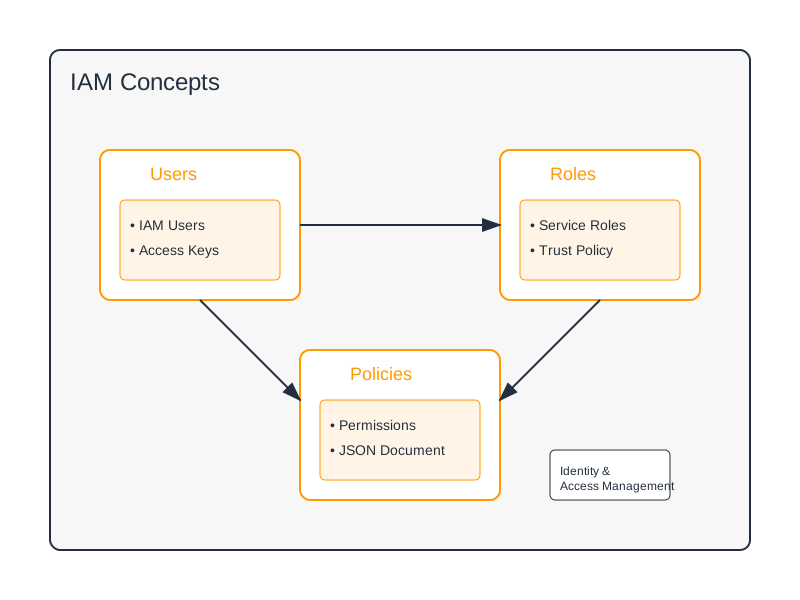
2. Implement Granular IAM Strategies
Identity and Access Management (IAM) is the cornerstone of AWS security. Overly permissive IAM policies are a primary vector for compromise.
IAM Security Pillars
| Practice | Description | Implementation Detail | Benefit | | :----------------------- | :------------------------------------------------------------------------------------------------------------------- | :----------------------------------------------------------------------------------------------------------------------------------------------------------------------------------------------------------------------------------------------------------------------- | :-------------------------------------------------------------------- | | Least Privilege | Grant only the minimum permissions necessary for a user, group, or role to perform its intended function. | Use IAM policies to explicitly define allowed actions. Avoid wildcard (
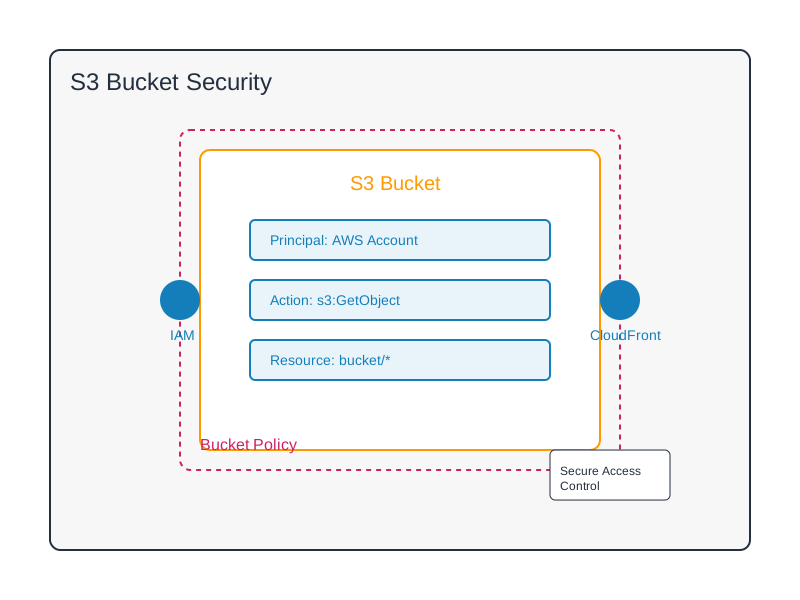
*ActionResourceExample Policy (Least Privilege for S3 Read-Only Access):
{
    "Version": "2012-10-17",
    "Statement": [
        {
            "Effect": "Allow",
            "Action": [
                "s3:GetObject",
                "s3:ListBucket"
            ],
            "Resource": [
                "arn:aws:s3:::my-secure-bucket",
                "arn:aws:s3:::my-secure-bucket/*"
            ]
        }
    ]
}
3. Implement Comprehensive Logging and Monitoring
Visibility is critical for detecting and responding to security incidents. AWS provides a suite of services for this purpose.
Logging and Monitoring Strategy
| Service | Purpose | Configuration Best Practices | Retention Policy | | :------------- | :----------------------------------------------------------------------------------- | :-------------------------------------------------------------------------------------------------------------------------------------------------------------------------------------------- | :---------------------------------------------------------------------------- | | AWS CloudTrail | Logs API calls made to your AWS account. Essential for auditing and forensics. | Enable CloudTrail in all regions. Configure it to log management events and data events (for critical resources like S3 buckets and Lambda functions). Send logs to a dedicated, secured S3 bucket. | Set to
NeverExample CloudWatch Log Metric Filter for Failed Logins:
- Navigate to CloudWatch -> Log groups.
- Select your CloudTrail log group.
- Click "Create Metric Filter".
- Filter Pattern:
{ ($.eventName = "ConsoleLogin") && ($.errorMessage = "Failed authentication") } - Assign metric: Create a new metric, e.g., , with a value of
FailedLogins.1 - Create Alarm: Set an alarm that triggers when the metric exceeds 5 within a 5-minute period, and send a notification to an SNS topic.
FailedLogins
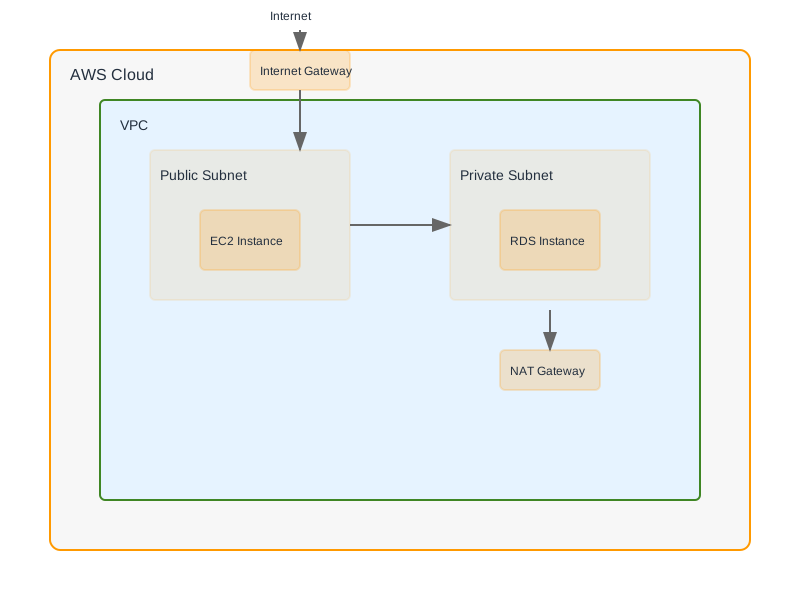
4. Implement Robust Network Security
AWS provides granular controls to secure your network infrastructure.
Network Security Controls
| Control | Implementation | Rationale | | :------------------- | :--------------------------------------------------------------------------------------------------------------------- | :----------------------------------------------------------------------------------------------------------------------------------------------------------------------------------------------------------------------------------------- | | Security Groups | Act as virtual firewalls for EC2 instances. Allow or deny traffic based on port, protocol, and source/destination IP. | Principle of least privilege: Only open necessary ports and protocols. Restrict source IP ranges to known trusted IPs (e.g., corporate VPN, bastion host). | | Network ACLs (NACLs) | Act as stateless firewalls for subnets. Control inbound and outbound traffic at the subnet level. | Provide an additional layer of defense. Can be used to block known malicious IP ranges at the subnet border. Remember they are stateless, so both inbound and outbound rules must be configured. | | VPC Design | Segment your network using subnets (public/private), route tables, and NAT Gateways/Instances. | Isolate sensitive resources (databases, application servers) in private subnets, accessible only via controlled ingress points (e.g., bastion hosts, load balancers). | | AWS WAF (Web Application Firewall) | Protects web applications from common web exploits and bots. | Deploy WAF rules to filter malicious traffic targeting HTTP/S requests to your web applications (e.g., SQL injection, cross-site scripting). Integrate with Application Load Balancers and CloudFront distributions. | | VPC Endpoints | Allow private connectivity to supported AWS services (e.g., S3, DynamoDB) from your VPC without traversing the public internet. | Enhances security by keeping traffic within the AWS network. Reduces exposure to internet-based threats. Use Gateway endpoints for S3 and DynamoDB, and Interface endpoints for other services. |
Example Security Group for a Web Server:
- Inbound Rules:
- Type: SSH, Protocol: TCP, Port range: 22, Source: or Bastion Host Security Group ID.
YOUR_CORP_IP/32 - Type: HTTP, Protocol: TCP, Port range: 80, Source: (or specific IP ranges if applicable).
0.0.0.0/0 - Type: HTTPS, Protocol: TCP, Port range: 443, Source: (or specific IP ranges if applicable).
0.0.0.0/0
- Type: SSH, Protocol: TCP, Port range: 22, Source:
- Outbound Rules:
- Allow all outbound traffic (common, but can be restricted if required).
5. Implement Data Protection Strategies
Protecting data, both at rest and in transit, is paramount.
Data Security Measures
| Measure | Service/Mechanism | Implementation Considerations