Building Enterprise-Grade Generative AI Applications: A Complete Guide
Learn how to design, develop, and deploy production-ready generative AI applications for enterprise use cases. Covers architecture patterns, security considerations, and scalability strategies.
Engineering Enterprise-Grade Generative AI Applications
This guide provides experienced engineers with a blueprint for constructing production-ready generative AI applications. We focus on the critical pillars of enterprise development: security, scalability, and reliability, detailing architectural patterns, implementation strategies, and best practices.
TL;DR
Developing enterprise-grade generative AI demands robust architectural choices and meticulous implementation. Prioritize security via granular access control and compliance. Design for scalability with distributed systems and efficient resource management. Ensure reliability through high availability and fault tolerance. Employ microservices or event-driven patterns, leverage CI/CD for deployment, and implement comprehensive monitoring and security measures.
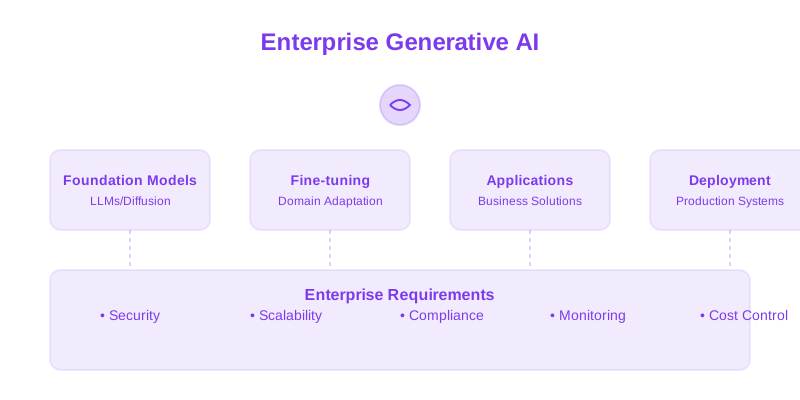
1. Enterprise Requirements for Generative AI
Beyond core functionality, enterprise AI applications must adhere to stringent operational and governance standards.
1.1. Security and Compliance
- Data Privacy and Protection: Implement end-to-end encryption, anonymization, and data masking techniques for sensitive information processed by LLMs. Understand and adhere to data residency requirements.
- Access Control and Authentication: Utilize robust authentication mechanisms (e.g., OAuth 2.0, OIDC) and fine-grained authorization (RBAC/ABAC) to restrict access to models, data, and sensitive features.
- Audit Logging and Monitoring: Maintain comprehensive, immutable audit logs of all model interactions, data access, and system changes for security analysis and compliance.
- Regulatory Compliance: Proactively address requirements from GDPR, HIPAA, CCPA, and industry-specific regulations concerning data handling, bias, and model explainability.
1.2. Scalability
- Horizontal and Vertical Scaling: Design systems to scale horizontally by adding more instances of services (e.g., LLM inference servers) and vertically by increasing resource allocation (CPU/GPU).
- Load Balancing and Distribution: Employ intelligent load balancing strategies to distribute requests across available inference endpoints, optimizing throughput and latency.
- Resource Optimization: Profile and optimize model inference (e.g., quantization, model pruning, batching) and infrastructure resource utilization to manage costs and performance.
- Cost Management: Implement strategies for cost monitoring, prediction, and optimization, especially for GPU-intensive inference workloads.
1.3. Reliability
- High Availability (HA) Design: Architect for HA using redundant components, multi-AZ deployments, and automated failover mechanisms.
- Fault Tolerance: Design services to gracefully handle failures in dependencies (e.g., vector databases, downstream APIs) using patterns like retries, circuit breakers, and bulkheads.
- Disaster Recovery (DR): Establish robust DR plans, including regular backups and tested recovery procedures, to ensure business continuity.
- Performance Optimization: Continuously monitor and optimize for latency, throughput, and resource utilization under varying load conditions.
2. Architectural Patterns for Generative AI
Selecting the right architectural pattern is crucial for managing complexity and meeting enterprise demands.
2.1. Microservices Architecture
This pattern decomposes the application into small, independent services, enabling better scalability, maintainability, and technology diversity.
Components:
- API Gateway: Single entry point, handles request routing, authentication, and rate limiting.
- Authentication Service: Manages user identity, tokens, and access permissions.
- LLM Service: Encapsulates the large language model inference logic, potentially managing model loading and GPU allocation.
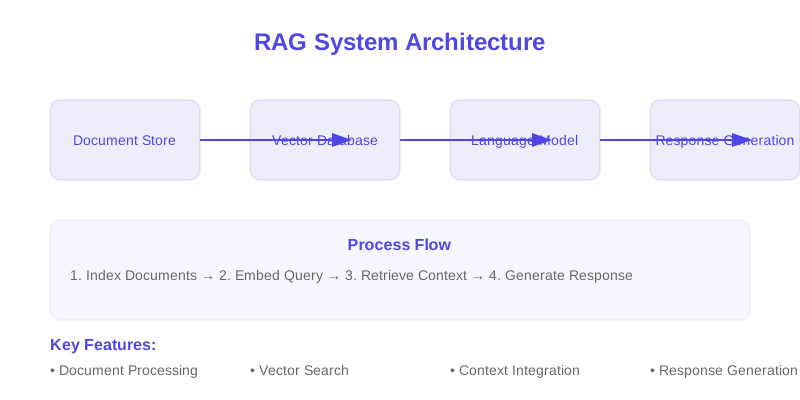
- Vector Store Service: Interfaces with a vector database for efficient similarity search (e.g., RAG).
- Model Registry: Stores and manages different versions of models.
- Document Store: For storing and retrieving source documents used in RAG.
Trade-offs:
- Pros: High scalability, independent deployments, fault isolation, technology diversity.
- Cons: Increased operational complexity, inter-service communication overhead, distributed tracing challenges.
2.2. Event-Driven Architecture (EDA)
EDA is ideal for asynchronous processing and decoupling components, particularly useful for complex workflows involving multiple AI services.
Components:
- Event Bus/Message Queue: A central hub for publishing and subscribing to events (e.g., Kafka, RabbitMQ, AWS SQS/SNS).
- LLM Processor: Consumes generation requests, interacts with LLMs, and publishes results.
- Content Filter: Processes input prompts or output responses for safety, compliance, or policy adherence.
- Audit Logger: Records events for security and compliance purposes.
- Response Handler: Consumes generation results and delivers them to clients or downstream systems.
Trade-offs:
- Pros: Decoupling, asynchronous processing, high scalability, resilience to component failures.
- Cons: Eventual consistency challenges, complex debugging, requires robust message brokering.
3. Implementation Guide
This section outlines practical steps and considerations for building your generative AI application.
3.1. Infrastructure Setup
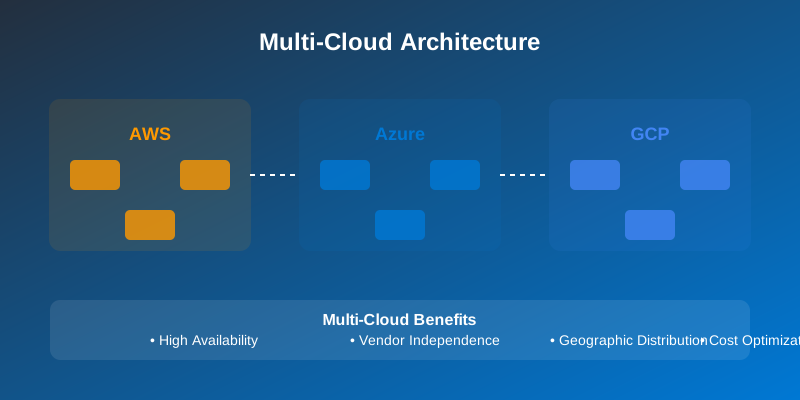
- Cloud Provider Selection: Evaluate providers (AWS, Azure, GCP) based on managed AI services, GPU availability, networking, security features, and cost.
- Resource Provisioning: Automate infrastructure provisioning using Infrastructure as Code (IaC) tools like Terraform or Pulumi. Securely manage credentials and secrets.
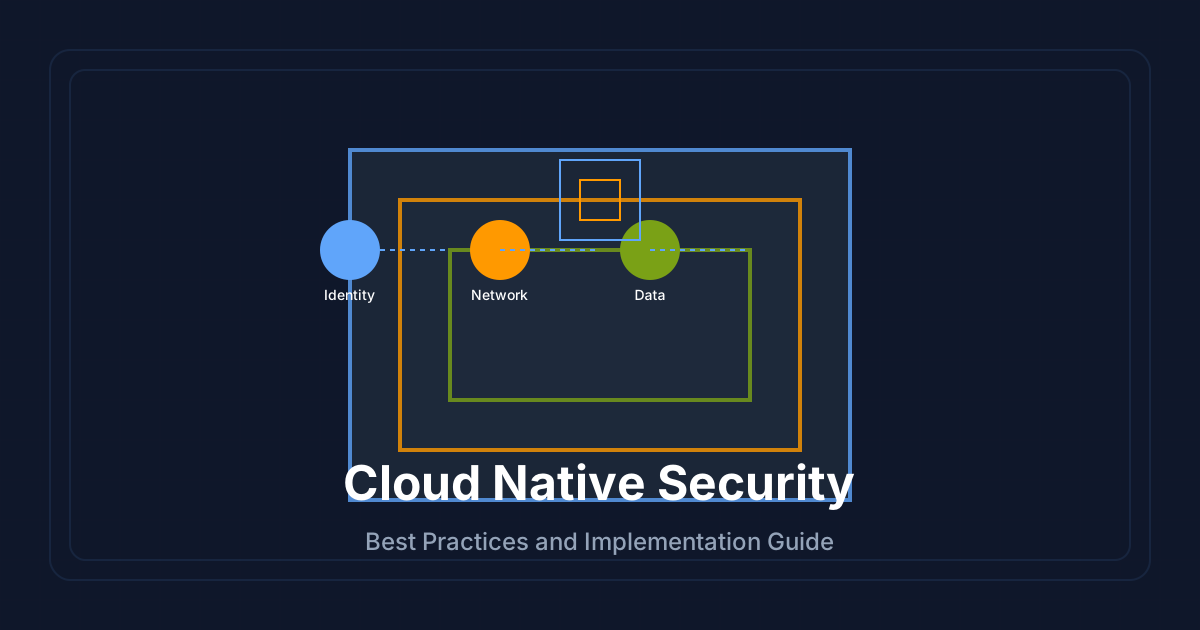
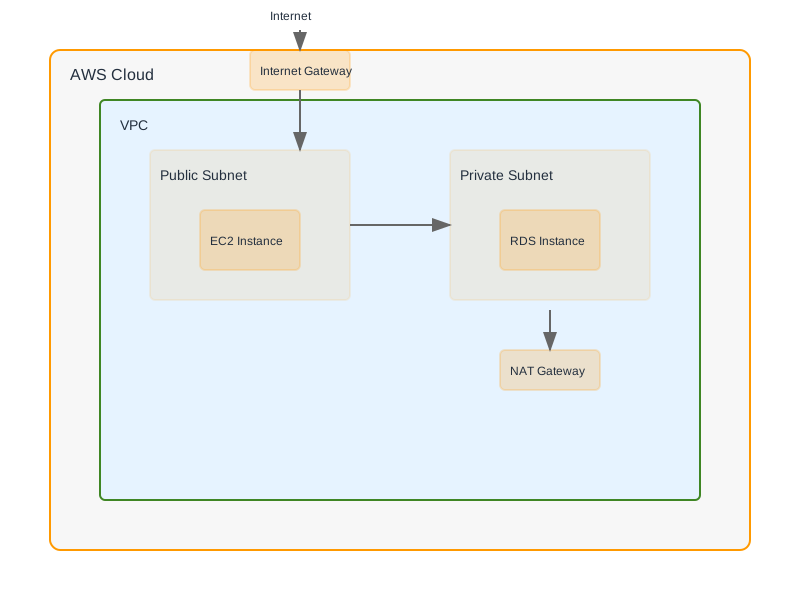
- Network Security: Configure VPCs, subnets, security groups, and network ACLs to isolate AI services. Implement private endpoints for managed services.
- Monitoring and Logging: Set up centralized logging (e.g., Elasticsearch, Splunk) and application performance monitoring (APM) tools (e.g., Datadog, New Relic) for observability.
3.2. Model Management and Deployment
- Model Versioning and Registry: Use tools like MLflow, DVC, or cloud-specific registries (e.g., SageMaker Model Registry, Azure ML Model Registry) to track, version, and manage model artifacts.
- A/B Testing Framework: Implement a framework to gradually roll out new model versions and compare their performance against existing ones using metrics like user engagement, accuracy, and cost.
- Model Performance Monitoring: Track key inference metrics (latency, throughput, error rates) and model-specific metrics (e.g., perplexity, ROUGE scores for text generation) in production.
- Automated Deployment Pipelines (CI/CD): Integrate model deployment into your CI/CD pipelines. This includes automated testing, artifact building, and phased rollouts (e.g., canary deployments).
3.3. Security Implementation
- Input Validation and Sanitization: Crucial for LLMs to prevent prompt injection attacks and unintended behavior. Validate prompt structure, length, and content. Sanitize user inputs before passing them to the model.
- Output Filtering and Sanitization: Review LLM outputs for harmful content, PII, or adherence to safety policies before presenting them to users.
- Access Control: Implement robust authentication and authorization for API endpoints.
# Example: FastAPI endpoint with authentication and input validation
from fastapi import FastAPI, Depends, HTTPException, Body
from pydantic import BaseModel
from typing import Optional

app = FastAPI()
# Assume oauth2_scheme and verify_token are defined elsewhere for authentication
# from security_utils import oauth2_scheme, verify_token

# Dummy verification function for demonstration
async def verify_token(token: str):
    if token == "valid-token":
        return {"username": "user123"}
    return None

oauth2_scheme = None # Placeholder, would be configured with actual OAuth setup

# Define a Pydantic model for input validation
class GenerationRequest(BaseModel):
    prompt: str
    max_tokens: int = 150
    temperature: float = 0.7

    # Example custom validator for prompt length
    # @validator('prompt')
    # def prompt_must_not_be_too_long(cls, v):
    #     if len(v) > 1000:
    #         raise ValueError('Prompt exceeds maximum length')
    #     return v

async def get_current_user(token: str = Depends(oauth2_scheme)): # type: ignore
    user = await verify_token(token)
    if not user:
        raise HTTPException(status_code=401, detail="Invalid authentication credentials")
    return user

@app.post("/generate")
async def generate_content(
    request: GenerationRequest = Body(...),
    current_user: dict = Depends(get_current_user)
):
    """
    Generates content based on a prompt.
    Requires authentication.
    """
    print(f"User {current_user['username']} requesting generation with prompt: {request.prompt[:50]}...")

    # --- Placeholder for actual LLM inference ---
    # Call your LLM inference service here, passing request.prompt, request.max_tokens, etc.
    # Example:
    # response_text = await call_llm_api(request.prompt, max_tokens=request.max_tokens, temperature=request.temperature)

    # --- Placeholder for output sanitization/filtering ---
    # sanitized_response = sanitize_output(response_text)

    # Simulate a response
    response_text = f"Generated content for: '{request.prompt[:30]}...' by {current_user['username']}"
    print("Generation successful.")

    return {"generated_text": response_text}

# Example of a security middleware to check for malicious content in prompts (conceptual)
async def check_prompt_safety(request: GenerationRequest = Body(...)):
    # In a real scenario, this would involve calling a safety model or rule-based system
    if "malicious_keyword" in request.prompt.lower():
        raise HTTPException(status_code=400, detail="Prompt contains unsafe content.")
    return request.prompt

@app.post("/generate_safe")
async def generate_content_safe(
    request: GenerationRequest = Body(...),
    prompt_content: str = Depends(check_prompt_safety), # Apply safety check
    current_user: dict = Depends(get_current_user)
):
    """
    Generates content after applying prompt safety checks.
    """
    print(f"User {current_user['username']} requesting safe generation...")
    # Proceed with generation using prompt_content
    response_text = f"Safely generated content for: '{prompt_content[:30]}...' by {current_user['username']}"
    return {"generated_text": response_text}
3.4. Scalability Patterns
- Load Balancing: Configure load balancers (e.g., Nginx, HAProxy, cloud LBs) at the API Gateway and for inference endpoints. Use health checks to remove unhealthy instances.
- Auto-Scaling Policies: Set up auto-scaling groups for LLM inference services based on CPU/GPU utilization, request queue length, or custom metrics.
- Caching: Implement caching for frequently asked questions or common prompt responses to reduce LLM inference load and latency.
- Rate Limiting: Protect your services from abuse and overload by implementing rate limiting at the API Gateway or service level.
4. Best Practices
Adhering to established best practices ensures maintainability, reliability, and security.
4.1. Development Workflow
- Version Control: Use Git for all code, configuration, and model artifacts. Employ a branching strategy (e.g., Gitflow, GitHub Flow).
- CI/CD Pipelines: Automate builds, testing (unit, integration, performance), and deployments. Include stages for security scanning and artifact management.
- Testing Strategies: Implement comprehensive testing:
- Unit Tests: For individual functions and modules.
- Integration Tests: For interactions between services (e.g., LLM Service and Vector Store).
- End-to-End Tests: Simulating user flows through the entire application.
- Model Evaluation Tests: Specific tests for model output quality, bias, and safety.
- Documentation: Maintain clear, up-to-date documentation for APIs, architecture, deployment, and troubleshooting.
4.2. Monitoring and Maintenance
- Performance Metrics: Monitor latency, throughput, error rates, resource utilization (CPU, GPU, memory), and cost per inference.
- Error Tracking: Implement centralized error logging and alerting for critical failures.
- Cost Monitoring: Set up dashboards and alerts for cloud spending, especially for GPU instances.
- Regular Updates: Keep dependencies, libraries, and underlying models updated to patch security vulnerabilities and benefit from improvements.
4.3. Security Measures
- Principle of Least Privilege: Grant only the necessary permissions to users and services.
- Secure Secrets Management: Use dedicated secrets management tools (e.g., HashiCorp Vault, AWS Secrets Manager, Azure Key Vault).
- Regular Security Audits: Conduct periodic penetration tests and vulnerability assessments.
5. Production Deployment
Deploying to production requires a structured approach to minimize risk.
5.1. Deployment Checklist
- [ ] Security Audit: Penetration testing and vulnerability scans completed and remediated.
- [ ] Performance Testing: Load and stress testing completed, latency and throughput targets met.
- [ ] Monitoring Setup: All critical metrics, logs, and alerts configured and verified.
- [ ] Backup Strategy: Backup and restore procedures tested and documented.
- [ ] Disaster Recovery Plan: DR plan documented and tested.
- [ ] Compliance Verification: All regulatory requirements verified.
- [ ] Rollback Plan: A clear, tested rollback procedure is in place.
- [ ] Documentation Update: All relevant documentation reflects the production configuration.
- [ ] Access Control Review: All production access credentials and permissions reviewed.
5.2. Deployment Strategy
Phased rollouts are essential to mitigate risk.
Key Deployment Patterns:
- Canary Deployment: Roll out to a small subset of users before a full rollout.
- Blue-Green Deployment: Maintain two identical production environments; switch traffic to the new version when ready.
- A/B Testing: Deploy multiple model versions concurrently and route traffic based on performance metrics or user segments.
6. When Not to Use Generative AI
While powerful, generative AI is not a panacea. Consider alternatives when:
- Deterministic, High-Precision Outputs Required: For tasks where absolute accuracy and predictability are paramount (e.g., financial calculations, safety-critical control systems), traditional algorithms or deterministic models are superior.
- No Suitable Training Data: If high-quality, relevant data for fine-tuning or RAG is unavailable or prohibitively expensive to acquire and label, performance will be poor.
- Computational Resources Are Severely Limited: LLM inference, especially for large models, can be resource-intensive (GPU, memory). If infrastructure is constrained, alternatives might be necessary.
- Explainability is a Hard Requirement and Models are Black Boxes: While techniques for LLM explainability are evolving, for deeply regulated or safety-critical domains requiring full auditability of decisions, opaque LLMs may not be suitable.
- Cost is an Absolute Constraint and Performance Needs are Modest: Running LLMs can be expensive. For simple tasks, traditional NLP or rule-based systems may be far more cost-effective.
- Security or Privacy Risks Outweigh Benefits: If the data being processed is extremely sensitive and cannot be adequately protected or anonymized, or if the risk of model misuse is too high, avoid generative AI.
7. Decision Checklist
Use this checklist to guide your strategic decisions:
| Aspect | Considerations | Decision & Rationale | | :--------------------------- | :-------------------------------------------------------------------------------------------------------------------------------------------------- | :-------------------------------------------------------------------------------------------------------------------------------------------------------------------------------------------------------------------------------------------------------------------------------------------------------------------------------------------------------------- | | Problem Suitability | Does the problem genuinely benefit from generative capabilities (content creation, summarization, creative tasks, complex reasoning)? | Yes/No/Partial: If No, explore traditional ML or rule-based systems. If Partial, consider hybrid approaches. | | Data Availability | Is there sufficient high-quality, relevant data for training/fine-tuning or RAG? What is the cost of data acquisition and preparation? | Sufficient/Insufficient: If Insufficient, evaluate data augmentation, synthetic data generation, or using pre-trained models with RAG. | | Security & Compliance | What are the PII/sensitive data handling requirements? What regulations apply (GDPR, HIPAA)? What are the acceptable risk levels? | High/Medium/Low: Dictates encryption, anonymization, access control strategies, and potential for on-premise or private cloud deployments. | | Scalability Needs | What are the expected peak and average loads? What are the latency requirements? | High/Medium/Low: Influences choice between microservices/EDA, load balancing, auto-scaling strategies, and potentially model optimization techniques. | | Reliability Requirements | What is the acceptable downtime? What are the RTO/RPO objectives? | High/Medium/Low: Drives decisions on HA architecture, disaster recovery plans, and fault tolerance patterns. | | Cost Constraints | What is the budget for development, infrastructure, and ongoing inference costs? | Strict/Moderate/Flexible: Impacts model selection (size vs. performance), choice of hardware (GPU vs. CPU), and optimization efforts. | | Technical Expertise | Does the team have expertise in MLOps, distributed systems, cloud infrastructure, and generative AI model deployment? | Present/Developing: Influences the complexity of architecture that can be managed and whether to leverage managed services. | | Model Selection | Which LLM (open-source, commercial API) best fits performance, cost, and security needs? Is fine-tuning required? What are the RAG requirements? | Specific Model/API: Based on benchmarks, cost, licensing, and fine-tuning capabilities. | | Architectural Pattern | Which pattern (Microservices, EDA, Hybrid) best addresses the integration complexity, scalability, and reliability needs? | Microservices/EDA/Hybrid: Choose based on the trade-offs discussed for balancing complexity, performance, and resilience. | | Deployment Strategy | How will new models and code be rolled out safely and efficiently? | Canary/Blue-Green/Phased: To minimize production risk. | | Monitoring & Observability | What metrics are critical to track for performance, cost, and errors? How will system health be diagnosed? | Comprehensive: Essential for operational stability and continuous improvement. |
Conclusion
Engineering enterprise-grade generative AI applications is a multifaceted challenge requiring a synthesis of robust software engineering principles and specialized AI/ML operational practices. By diligently addressing security, scalability, and reliability from the outset, and by adopting well-defined architectural patterns and development workflows, organizations can successfully deploy and manage sophisticated generative AI solutions that deliver sustained business value.