Building and Deploying Applications on Google App Engine
Learn how to deploy and scale applications on Google App Engine. This guide covers standard and flexible environments, configuration options, and best practices for optimal performance.
Building and Deploying Applications on Google App Engine
Google App Engine (GAE) is a fully managed Platform-as-a-Service (PaaS) that makes deploying and scaling applications easy. This guide covers everything you need to know about using App Engine effectively.
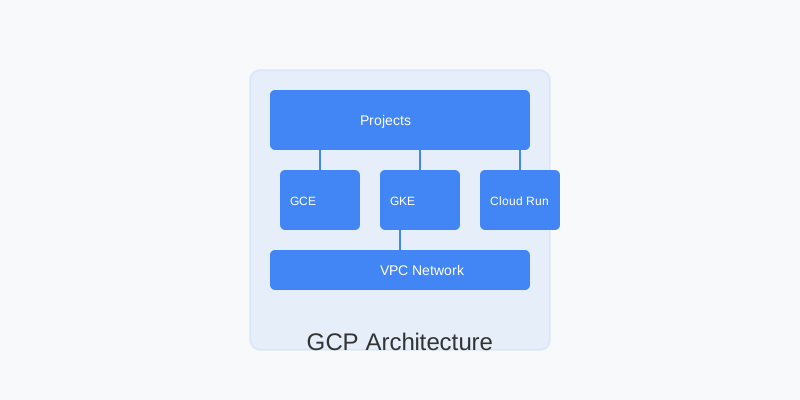
Architecture Overview
Environment Comparison
| Feature | Standard Environment | Flexible Environment | |---------|---------------------|---------------------| | Startup | Seconds | Minutes | | SSH Access | No | Yes | | Network Access | Via App Engine services | Full network access | | Pricing | Per instance hour | Per vCPU, memory, disk | | Scale to Zero | Yes | No | | Custom Runtime | No | Yes (Docker) |
Getting Started
1. Standard Environment Setup
Example Python application:
# main.py
from flask import Flask

app = Flask(__name__)

@app.route('/')
def hello():
    return 'Hello from App Engine!'

if __name__ == '__main__':
    app.run(host='127.0.0.1', port=8080, debug=True)
Configuration file:
# app.yaml
runtime: python39
instance_class: F1

automatic_scaling:
  target_cpu_utilization: 0.65
  min_instances: 1
  max_instances: 10

handlers:
- url: /.*
  script: auto
2. Flexible Environment Setup
# app.yaml
runtime: custom
env: flex

manual_scaling:
  instances: 2

resources:
  cpu: 1
  memory_gb: 2
  disk_size_gb: 10

env_variables:
  ENV: 'production'
Dockerfile for custom runtime:
FROM python:3.9-slim

WORKDIR /app
COPY requirements.txt .
RUN pip install -r requirements.txt

COPY . .
CMD gunicorn -b :$PORT main:app
Deployment and Management
1. Deploying Applications
# Deploy application
gcloud app deploy app.yaml

# Deploy specific version
gcloud app deploy app.yaml --version=v1

# Deploy with traffic splitting
gcloud app deploy app.yaml --version=v2 --no-promote
2. Managing Versions
# List versions
gcloud app versions list

# Split traffic
gcloud app services set-traffic default \
  --splits=v1=0.5,v2=0.5

# Migrate traffic
gcloud app services set-traffic default \
  --splits=v2=1 \
  --migrate
Configuration Options
1. Scaling Configuration
# Automatic scaling
automatic_scaling:
  target_cpu_utilization: 0.65
  target_throughput_utilization: 0.6
  min_instances: 1
  max_instances: 10
  max_concurrent_requests: 50

# Basic scaling
basic_scaling:
  max_instances: 5
  idle_timeout: 10m

# Manual scaling
manual_scaling:
  instances: 3
2. Environment Variables
env_variables:
  DATABASE_URL: 'postgresql://user:pass@host:5432/db'
  API_KEY: '${SECRET_KEY}'
  CACHE_TTL: '3600'
Advanced Features
1. Custom Domains
# Map custom domain
gcloud app domain-mappings create \
  --domain=www.example.com

# Update SSL certificate
gcloud app ssl-certificates update \
  --display-name=main-cert \
  --domain=www.example.com
2. Task Queues
# queue.yaml
queue:
- name: default
  rate: 5/s
  bucket_size: 10
  retry_parameters:
    task_retry_limit: 3
    min_backoff_seconds: 30
Security Best Practices
1. Identity and Access Management
# Set IAM policy
gcloud app set-iam-policy policy.yaml

# Grant access
gcloud projects add-iam-policy-binding PROJECT_ID \
  --member="user:jane@example.com" \
  --role="roles/appengine.deployer"
2. Firewall Rules
# Create firewall rule
gcloud app firewall-rules create allow-internal \
  --action allow \
  --source-range 10.0.0.0/8 \
  --description "Allow internal traffic"
Monitoring and Logging
1. Viewing Logs
# View application logs
gcloud app logs tail

# Read specific logs
gcloud logging read "resource.type=gae_app" \
  --project=PROJECT_ID \
  --limit=10
2. Monitoring Metrics
Key metrics to monitor:
- Instance count
- Request latency
- Error rates
- Memory usage
- CPU utilization
Performance Optimization
1. Caching Strategies
# Using Memcache
from google.appengine.api import memcache

def get_data(key):
    data = memcache.get(key)
    if data is None:
        data = fetch_from_database(key)
        memcache.add(key, data, 3600)  # Cache for 1 hour
    return data
2. Static File Handling
# app.yaml
handlers:
- url: /static
  static_dir: static
  http_headers:
    Cache-Control: public, max-age=3600

- url: /.*
  script: auto
Troubleshooting
1. Common Issues
# Check application status
gcloud app describe

# View instance details
gcloud app instances list

# Debug routing issues
gcloud app routes list
2. Health Checks
# app.yaml
health_check:
  enable_health_check: true
  check_interval_sec: 5
  timeout_sec: 4
  unhealthy_threshold: 2
  healthy_threshold: 2
Cost Optimization
-
Instance Management
- Use automatic scaling
- Set appropriate instance classes
- Implement efficient caching
- Use CDN for static content
-
Resource Utilization
- Monitor and adjust instance count
- Optimize database queries
- Use asynchronous tasks
- Implement proper caching
Conclusion
Google App Engine provides a robust platform for deploying and scaling applications. Key takeaways:
- Choose the right environment (Standard vs Flexible)
- Implement proper scaling strategies
- Use built-in services effectively
- Monitor performance and costs
- Follow security best practices
For more information, refer to the official App Engine documentation.