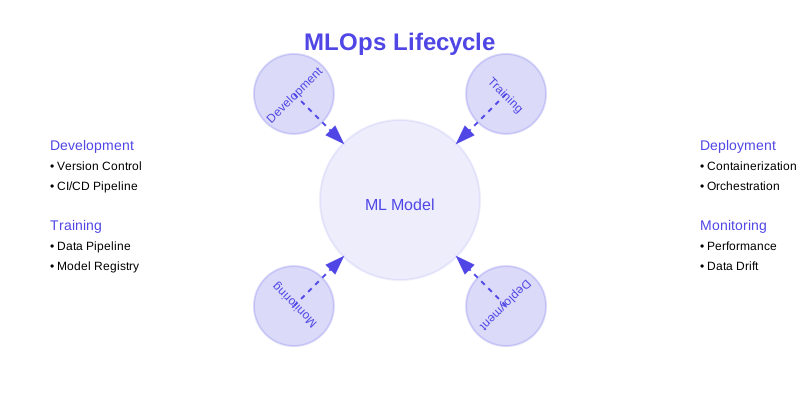
MLOps Best Practices: From Development to Production
Master MLOps best practices with our comprehensive guide covering model development, deployment pipelines, monitoring, and scaling strategies for production ML systems.
Engineering MLOps: From Development to Production
TL;DR: This guide outlines robust MLOps practices for engineering teams, covering version control, automated pipelines, deployment, continuous monitoring, and scaling, with a focus on practical implementation and avoiding common pitfalls.
Introduction to MLOps Engineering
Machine Learning Operations (MLOps) is a discipline that integrates Machine Learning (ML) development with DevOps and Data Engineering principles. Its primary goal is to establish standardized and automated processes for deploying, managing, and maintaining ML models in production environments reliably and efficiently.
Core Principles
MLOps engineering is built upon several key pillars:
- Automation: Automating repetitive tasks in the ML lifecycle, from data preprocessing to model deployment and monitoring.
- Reproducibility: Ensuring that ML experiments and production deployments can be reliably reproduced.
- Collaboration: Fostering seamless collaboration between data scientists, ML engineers, and operations teams.
- Monitoring: Continuously tracking model performance, data drift, and system health in production.
- Governance: Establishing clear processes for model lifecycle management, including versioning, lineage, and access control.
Key Components of an MLOps Stack
A comprehensive MLOps stack typically includes:
- Version Control:
- Code: Git for all ML code, including training scripts, feature engineering, and inference services.
- Data: Tools like DVC (Data Version Control) or similar solutions to version datasets and track data lineage.
- Models: Model registries (e.g., MLflow Model Registry, SageMaker Model Registry) to store and manage trained model artifacts, along with their metadata and versions.
- Experiment Tracking & Model Management:
- Tools like MLflow, Weights & Biases, or Comet ML to log experiments, parameters, metrics, and artifacts, enabling reproducibility and comparison.
- CI/CD Pipelines:
- Automated pipelines for building, testing, and deploying ML models. This includes data validation, model training, model evaluation, and deployment to serving infrastructure.
- Model Serving & Inference:
- Frameworks and platforms for deploying models as APIs (e.g., FastAPI, Flask with Docker, Kubernetes, cloud-managed services like SageMaker Endpoints, Vertex AI Endpoints).
- Monitoring & Alerting:
- Systems for tracking model performance (accuracy, drift), operational metrics (latency, throughput, error rates), and alerting on anomalies. Tools include Prometheus, Grafana, and specialized ML monitoring platforms.
- Feature Store (Optional but Recommended):
- A centralized repository for curated and versioned features, ensuring consistency between training and inference and reducing redundant feature engineering.
Building Robust MLOps Pipelines
1. Version Control Strategies
Effective version control is foundational. Consider the following:
- Code Versioning: Standard Git practices apply. Use feature branches, pull requests, and clear commit messages.
- Data Versioning: For datasets, use tools that track changes and allow rollback.
- Example (DVC ):
dvc.yaml
This DVC configuration defines reproducible data processing stages, linking commands to their dependencies and outputs.stages: data_ingestion: cmd: dvc run -n ingest_data -d src/ingest.py -o data/raw python src/ingest.py deps: - src/ingest.py outs: - data/raw data_processing: cmd: dvc run -n process_data -d data/raw -d src/process.py -o data/processed python src/process.py deps: - data/raw - src/process.py outs: - data/processed
- Example (DVC
- Model Artifact Versioning: Store trained models, their configurations, and relevant metadata.
- Example (MLflow Experiment Logging):
This code snippet demonstrates logging parameters, metrics, and saving a scikit-learn model within an MLflow run. Theimport mlflow import mlflow.sklearn from sklearn.ensemble import RandomForestClassifier from sklearn.model_selection import train_test_split from sklearn.datasets import load_iris # Load data iris = load_iris() X_train, X_test, y_train, y_test = train_test_split(iris.data, iris.target, test_size=0.2, random_state=42) # Start an MLflow run with mlflow.start_run(run_name="RandomForest Training"): # Log parameters params = {"n_estimators": 100, "max_depth": 5} mlflow.log_params(params) # Train model model = RandomForestClassifier(**params) model.fit(X_train, y_train) # Log metrics accuracy = model.score(X_test, y_test) mlflow.log_metric("accuracy", accuracy) print(f"Model Accuracy: {accuracy}") # Log the model mlflow.sklearn.log_model(model, "random-forest-model", registered_model_name="IrisForestModel") print("MLflow run completed. Model logged.")argument initiates registration in the MLflow Model Registry.registered_model_name
- Example (MLflow Experiment Logging):
2. Automated Training and Evaluation Pipelines
Automate the entire model training lifecycle to ensure consistency and speed.
-
Components:
- Data validation and cleansing.
- Feature engineering.
- Model training with hyperparameter tuning.
- Model evaluation against predefined metrics and baseline models.
- Model registration in a model registry if performance criteria are met.
-
Example (Conceptual Pipeline Orchestration): Using tools like Kubeflow Pipelines, Airflow, or MLflow Projects, you can define a DAG (Directed Acyclic Graph) of tasks.
# Example using Kubeflow Pipelines (simplified)
from kfp import dsl
from kfp.dsl import PipelineParam

@dsl.pipeline(
    name='ML Model Training Pipeline',
    description='Orchestrates ML model training and evaluation.'
)
def ml_training_pipeline(
    data_path: str = 'gs://my-bucket/data/processed',
    model_output_path: str = 'gs://my-bucket/models'
):
    # Component 1: Data Validation
    data_validation_op = dsl.ContainerOp(
        name='data-validation',
        image='my-registry/data-validator:latest',
        arguments=[
            '--data-path', data_path,
            '--output-path', '/outputs/validation_report.json'
        ],
        file_outputs={'validation_report': '/outputs/validation_report.json'}
    )

    # Component 2: Model Training
    train_model_op = dsl.ContainerOp(
        name='train-model',
        image='my-registry/trainer:latest',
        arguments=[
            '--data-path', data_path,
            '--output-path', '/outputs/model',
            '--validation-report', data_validation_op.outputs['validation_report']
        ],
        file_outputs={'trained_model': '/outputs/model'}
    )

    # Component 3: Model Evaluation
    evaluate_model_op = dsl.ContainerOp(
        name='evaluate-model',
        image='my-registry/evaluator:latest',
        arguments=[
            '--model-path', train_model_op.outputs['trained_model'],
            '--data-path', data_path,
            '--output-path', '/outputs/evaluation_metrics.json'
        ],
        file_outputs={'evaluation_metrics': '/outputs/evaluation_metrics.json'}
    )

    # Add conditional logic for registration based on metrics
    # ...

# Compile and run the pipeline
# from kfp import compiler
# compiler.Compiler().compile(ml_training_pipeline, 'ml_training_pipeline.yaml')
This abstract example shows how different stages (data validation, training, evaluation) can be chained together as containerized components within a pipeline orchestration framework.
Best Practices for Production Readiness
1. Versioning and Reproducibility
- Immutable Artifacts: Ensure that once a model or dataset version is committed, it remains unchanged.
- Dependency Management: Pin exact versions of libraries (e.g., ,
requirements.txt) to guarantee reproducibility.environment.yaml - Model Registry: Use a model registry to store validated model versions, associate them with specific experiments, and manage their lifecycle (e.g., Staging, Production, Archived).
2. Comprehensive Monitoring and Logging
- Operational Metrics: Log system-level metrics for deployed models.
- Example (Prometheus Integration):
This code demonstrates how to instrument an inference service with Prometheus metrics for request counts, latency, and active version.# In your inference service from prometheus_client import Counter, Histogram, Gauge import time # Define metrics prediction_requests_total = Counter( 'ml_inference_requests_total', 'Total number of inference requests received.', ['model_name', 'model_version'] ) prediction_latency_seconds = Histogram( 'ml_inference_latency_seconds', 'Latency of inference requests in seconds.', ['model_name', 'model_version'], buckets=[0.01, 0.05, 0.1, 0.5, 1, 5, float('inf')] ) model_version_gauge = Gauge( 'ml_model_version_info', 'Information about the currently deployed model version.', ['model_name', 'model_version'] ) def predict(model, data): model_name = "my_model" model_version = "v1.2.0" # Assume this is known start_time = time.time() try: prediction_requests_total.labels(model_name=model_name, model_version=model_version).inc() response = model.predict(data) return response finally: latency = time.time() - start_time prediction_latency_seconds.labels(model_name=model_name, model_version=model_version).observe(latency) # Set current version info on startup model_version_gauge.labels(model_name="my_model", model_version="v1.2.0").set(1)
- Example (Prometheus Integration):
- Model Performance Metrics: Track business-relevant metrics and ML-specific metrics (accuracy, precision, recall, AUC, etc.) on live data.
- Data Drift: Monitor input data distributions and feature statistics for significant deviations from the training data.
- Concept Drift: Monitor changes in the relationship between input features and the target variable.
- Logging: Centralize logs for debugging and auditing.
3. Rigorous Testing and Validation
- Data Validation:
- Schema Validation: Ensure data conforms to expected formats and types.
- Statistical Validation: Check distributions and ranges against expectations.
- Model Validation:
- Offline Evaluation: Evaluate model performance on held-out datasets.
- Online Evaluation (A/B Testing): Compare new model versions against existing ones in production.
- Integration Testing: Verify that the model inference service interacts correctly with other system components.
- Load Testing: Ensure the inference service can handle anticipated traffic volumes.
Production Deployment Strategies
1. Containerization
Package your ML model and its dependencies into a container image for consistent deployment.
- Example (Dockerfile for a Flask API):
This Dockerfile defines a minimal Python environment, installs dependencies, copies application code, and exposes a port for the inference API.FROM python:3.9-slim WORKDIR /app # Copy only requirements first to leverage Docker cache COPY requirements.txt ./ RUN pip install --no-cache-dir -r requirements.txt # Copy application code COPY ./src /app/src COPY app.py /app/ EXPOSE 8080 # Command to run the application CMD ["python", "app.py"]
2. Orchestration and Serving
- Kubernetes: A de facto standard for orchestrating containerized applications.
- Example (Kubernetes Deployment):
This YAML defines a Kubernetes Deployment to manage model inference pods, including resource limits, health checks, and a Service for network access.apiVersion: apps/v1 kind: Deployment metadata: name: ml-inference-service labels: app: ml-inference spec: replicas: 3 # Number of pods to run selector: matchLabels: app: ml-inference template: metadata: labels: app: ml-inference spec: containers: - name: inference-container image: your-docker-registry/ml-model-inference:v1.5.0 # Specify your image ports: - containerPort: 8080 resources: # Define resource requests and limits requests: memory: "512Mi" cpu: "250m" limits: memory: "1Gi" cpu: "500m" livenessProbe: # Health check httpGet: path: /health # Assuming an /health endpoint port: 8080 initialDelaySeconds: 15 periodSeconds: 20 readinessProbe: # Readiness check httpGet: path: /ready # Assuming a /ready endpoint port: 8080 initialDelaySeconds: 5 periodSeconds: 10 --- apiVersion: v1 kind: Service metadata: name: ml-inference-service-clusterip spec: selector: app: ml-inference ports: - protocol: TCP port: 80 targetPort: 8080 type: ClusterIP # Or LoadBalancer for external access
- Example (Kubernetes Deployment):
- Managed Cloud Services: AWS SageMaker, Google Vertex AI, Azure ML offer managed endpoints for simplified deployment.
- Deployment Patterns:
- Blue/Green Deployments: Minimize downtime by running new and old versions in parallel.
- Canary Releases: Gradually roll out new versions to a subset of users.
- A/B Testing: Route traffic to different model versions for performance comparison.
Model Monitoring and Management in Production
1. Performance and Data Drift Monitoring
- Metrics Dashboard: Visualize key metrics using tools like Grafana, Datadog, or specialized ML monitoring platforms.
- Drift Detection: Implement statistical tests (e.g., Kolmogorov-Smirnov, Population Stability Index) to detect significant shifts in data distributions.
- Alerting: Configure alerts for critical metric thresholds or detected drifts.
- Example (Alert Configuration Snippet):
This illustrates how alert rules might be defined, specifying metrics, thresholds, conditions, and notification mechanisms.# Example conceptual alert configuration for a monitoring system alert_rules = [ { 'name': 'High Prediction Latency', 'metric': 'ml_inference_latency_seconds_sum', # Sum of latencies 'threshold': 600, # e.g., 10 minutes in seconds for sum over last hour 'condition': '>', 'for': '5m', # Alert if condition persists for 5 minutes 'severity': 'warning', 'target_labels': {'app': 'ml-inference'}, 'notification_channel': 'slack' }, { 'name': 'Significant Data Drift in Feature X', 'metric': 'feature_x_population_stability_index', 'threshold': 0.2, # Example threshold for PSI 'condition': '>', 'for': '1h', 'severity': 'critical', 'target_labels': {'app': 'ml-inference'}, 'notification_channel': 'pagerduty' } ]
- Example (Alert Configuration Snippet):
2. Model Retraining and Updates
- Triggering Retraining:
- Scheduled (e.g., weekly, monthly).
- Performance degradation below a threshold.
- Significant data or concept drift detected.
- Automated Retraining Pipeline: Integrate retraining into CI/CD pipelines.
- Champion/Challenger Models: Maintain a "champion" (currently deployed) model and test "challenger" models against it.
Scaling MLOps Practices
1. Infrastructure and Resource Management
- Scalable Compute: Leverage cloud-based auto-scaling groups, Kubernetes Horizontal Pod Autoscalers, or serverless functions.
- Distributed Training: For large models or datasets, use frameworks like Horovod or PyTorch Distributed.
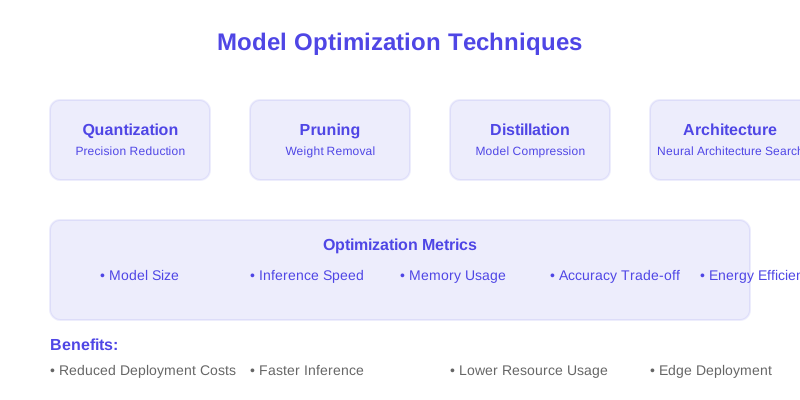
- Efficient Serving: Employ techniques like model quantization, batching, and optimized inference runtimes (e.g., ONNX Runtime, TensorRT).
- Cost Optimization: Monitor resource utilization, implement spot instances where appropriate, and right-size infrastructure.
2. Team Structure and Collaboration
- Cross-Functional Teams: Embed ML engineers within product teams or establish dedicated MLOps teams that collaborate closely with data science and operations.
- Defined Roles: Clearly delineate responsibilities for data scientists, ML engineers, DevOps engineers, and MLOps specialists.
- Standardized Tooling: Agree on and standardize the MLOps toolchain to reduce complexity and improve knowledge sharing.
- Documentation: Maintain comprehensive documentation for pipelines, models, deployment procedures, and monitoring dashboards.
Common Challenges and Solutions
- Data Skew/Drift:
- Solution: Robust data validation at ingestion and inference, continuous monitoring for drift, and automated retraining triggers.
- Reproducibility Issues:
- Solution: Rigorous version control for code, data, and models; explicit dependency management; containerization.
- Model Performance Degradation:
- Solution: Continuous performance monitoring, concept drift detection, and establishing clear retraining policies.
- Scalability Bottlenecks:
- Solution: Infrastructure scaling (Kubernetes, cloud services), efficient model serving, and performance testing.
- Lack of Governance and Auditability:
- Solution: Implement model registries, lineage tracking, access controls, and robust logging.
Conclusion
Engineering MLOps requires a systematic approach that extends beyond model development. By focusing on automation, versioning, comprehensive monitoring, and scalable infrastructure, organizations can reliably deploy, manage, and iterate on ML models in production, unlocking their full business value.
Further Reading and Resources
- MLflow: https://www.mlflow.org/ - For experiment tracking, model packaging, and registry.
- DVC (Data Version Control): https://dvc.org/ - For data and model versioning.
- Kubeflow: https://www.kubeflow.org/ - For building and deploying ML workflows on Kubernetes.
- Prometheus: https://prometheus.io/ - For time-series monitoring and alerting.
- Grafana: https://grafana.com/ - For data visualization and dashboarding.
- Docker: https://www.docker.com/ - For containerization.
- Kubernetes: https://kubernetes.io/ - For container orchestration.
- AWS SageMaker: https://aws.amazon.com/sagemaker/
- Google Cloud Vertex AI: https://cloud.google.com/vertex-ai
- Azure Machine Learning: https://azure.microsoft.com/en-us/products/machine-learning/
When Not to Use Advanced MLOps
While MLOps offers significant benefits, it's not always the optimal solution for every scenario. Consider alternatives when:
- Small-Scale, Exploratory Projects: For one-off experiments or academic projects with no intention of production deployment, the overhead of a full MLOps pipeline might be prohibitive. Simple scripts and manual tracking may suffice.
- Static Models with Stable Data: If your model's performance is stable, the underlying data distribution rarely changes, and there's no need for frequent updates, overly complex MLOps infrastructure can be overkill.
- Extremely Resource-Constrained Environments: Implementing sophisticated MLOps tooling can require significant infrastructure and expertise. If these are severely limited, simpler, more manual processes might be necessary.
- Non-ML Production Systems: MLOps is specifically for machine learning systems. Traditional software engineering DevOps practices are sufficient for non-ML applications.
- Teams Lacking ML/DevOps Expertise: A rushed or poorly implemented MLOps strategy can create more problems than it solves. It's better to start simple and evolve rather than adopt complex tools without adequate understanding or skilled personnel.
MLOps Decision Checklist
Before investing heavily in MLOps infrastructure and processes, evaluate your needs using this checklist:
Project Scope & Lifecycle
- [ ] Production Viability: Is this ML model intended for production use with real users/systems?
- [ ] Long-Term Maintenance: Is the model expected to be maintained, updated, or retrained over time?
- [ ] Scalability Requirements: Will the model need to handle increasing data volumes or user traffic?
- [ ] Reproducibility Need: Is it critical to reproduce past model training runs or deployments for auditing or debugging?
Data Characteristics
- [ ] Data Volatility: Is the input data distribution expected to change over time (data drift)?
- [ ] Data Volume: Are datasets large enough to warrant specialized versioning or processing tools?
- [ ] Data Sources: Are there multiple, diverse data sources that need consistent handling?
Model Characteristics
- [ ] Performance Sensitivity: Is the model's performance critically important, requiring constant monitoring?
- [ ] Model Complexity: Is the model architecture complex, with many dependencies?
- [ ] Update Frequency: Is there a need for frequent model updates or A/B testing of new versions?
Team & Resources
- [ ] Team Expertise: Does the team have or can it acquire the necessary skills for ML engineering and DevOps?
- [ ] Resource Availability: Are sufficient compute, storage, and personnel resources available for MLOps tooling?
- [ ] Budget: Is there a budget allocated for MLOps tools, infrastructure, and training?
Governance & Compliance
- [ ] Auditing Requirements: Are there regulatory or business requirements for auditing ML model behavior and lineage?
- [ ] Access Control: Is granular control over model versions and deployment environments necessary?
Decision Guidance:
- Mostly "No": Consider simpler, manual approaches or basic scripting.
- A Mix of "Yes" and "No": Start with core MLOps practices (version control, basic CI/CD for training) and gradually adopt more advanced tools as needed.
- Mostly "Yes": Proceed with implementing a comprehensive MLOps strategy, selecting tools that align with your specific needs and team capabilities.