Developing Autonomous AI Agents: From Theory to Implementation
Master the development of autonomous AI agents. Learn about agent architectures, decision-making systems, and practical implementation strategies for real-world applications.
Building Autonomous AI Agents: A Practical Engineering Guide
TL;DR: This guide provides experienced engineers with a structured approach to developing autonomous AI agents. It covers core components, architectural patterns, practical implementation steps with code examples, advanced topics like multi-agent systems and safety, best practices for development and optimization, and deployment considerations.
Introduction
Autonomous AI agents represent a significant evolution in artificial intelligence, enabling systems to perceive their environment, make independent decisions, and execute actions to achieve defined goals. This guide focuses on the engineering aspects of building these agents, moving from foundational concepts to actionable implementation strategies.
Core Components of an Autonomous Agent
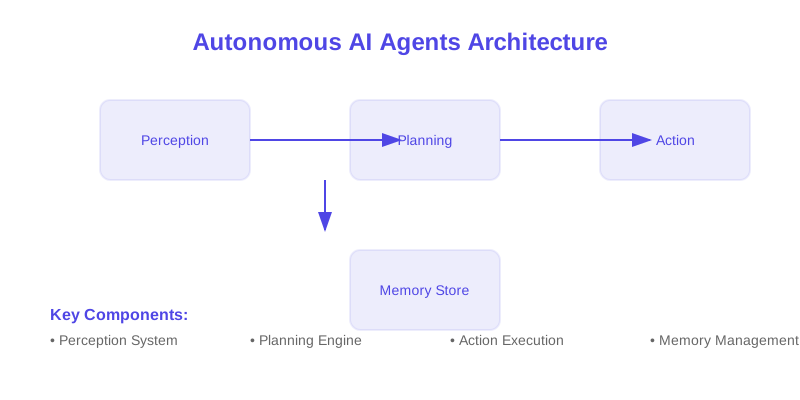
An autonomous agent integrates several key functional blocks:
-
Perception System:
- Sensor Data Fusion: Ingesting and processing raw data from various sensors (e.g., cameras, LiDAR, microphones, internal state sensors).
- Environment Understanding: Constructing a coherent internal representation of the external world from sensor data, often involving object detection, scene segmentation, and localization.
- State Estimation: Maintaining and updating the agent's current state and the state of relevant environmental entities, accounting for sensor noise and uncertainty.
- Feature Extraction: Identifying and extracting salient features from the environment relevant to decision-making.
-
Decision-Making Module:
- Planning Algorithms: Generating sequences of actions to reach a goal (e.g., A*, RRT, model predictive control).
- Policy Learning: Deriving an optimal mapping from states to actions, typically through reinforcement learning or imitation learning.
- Action Selection: Choosing the specific action to execute in the current state based on the learned or planned policy.
- Goal Management: Decomposing high-level goals into sub-goals and managing their progress.
-
Action Execution System:
- Control Systems: Translating selected actions into low-level commands for actuators (e.g., motor commands, API calls).
- Feedback Loops: Utilizing sensor readings to monitor the outcome of executed actions and adjust subsequent actions.
- Error Handling: Detecting and responding to unexpected outcomes or failures in action execution.
- Safety Mechanisms: Implementing constraints and fallback procedures to ensure safe operation within predefined limits.
Agent Architectures and Design Patterns
Perception-Action Loop (Reactive Agents)
This fundamental architecture describes agents that directly map perceptions to actions, often characterized by fast response times.
- Pros: Simplicity, low latency, suitable for well-defined, dynamic environments.
- Cons: Limited foresight, difficulty handling complex, long-term tasks, can be brittle to unseen states.
Agents with Memory and Learning
To address the limitations of purely reactive agents, memory and learning capabilities are incorporated.
- Pros: Ability to learn from past experiences, adapt to changing environments, and plan for future outcomes.
- Cons: Increased complexity, potential for slow learning, requires careful management of memory and learning algorithms.
Implementation Guide
Environment Setup
A robust environment simulation or interface is crucial for training and testing agents.
import numpy as np

class AbstractEnvironment:
    """
    Abstract base class for defining an environment for autonomous agents.
    """
    def __init__(self, config=None):
        self.config = config if config is not None else {}
        self.state = self._initialize_state()
        self.reward_function = self._define_rewards()
        self.time_step = 0

    def _initialize_state(self):
        """Initializes the environment's state."""
        raise NotImplementedError

    def _define_rewards(self):
        """Defines the reward function."""
        raise NotImplementedError

    def step(self, action):
        """
        Executes an action in the environment and returns the next state, reward, and done flag.

        Args:
            action: The action taken by the agent.

        Returns:
            tuple: (next_state, reward, done, info)
        """
        raise NotImplementedError

    def reset(self):
        """Resets the environment to an initial state."""
        self.state = self._initialize_state()
        self.time_step = 0
        return self.state

    def render(self):
        """Optional: Renders the environment state."""
        pass

# Example concrete implementation (simplified grid world)
class GridWorld(AbstractEnvironment):
    def __init__(self, grid_size=5, start_pos=(0, 0), goal_pos=(4, 4), config=None):
        super().__init__(config)
        self.grid_size = grid_size
        self.start_pos = start_pos
        self.goal_pos = goal_pos

        self.state = self._initialize_state()
        self.reward_function = self._define_rewards()
        self.possible_actions = ['up', 'down', 'left', 'right']

    def _initialize_state(self):
        return {'agent_pos': self.start_pos}

    def _define_rewards(self):
        def reward_func(current_state):
            if current_state['agent_pos'] == self.goal_pos:
                return 1.0
            else:
                return -0.1 # Small penalty for each step
        return reward_func

    def _is_valid_pos(self, pos):
        x, y = pos
        return 0 <= x < self.grid_size and 0 <= y < self.grid_size

    def step(self, action):
        if action not in self.possible_actions:
            raise ValueError(f"Invalid action: {action}")

        current_pos = self.state['agent_pos']
        x, y = current_pos

        if action == 'up':
            next_pos = (x, y - 1)
        elif action == 'down':
            next_pos = (x, y + 1)
        elif action == 'left':
            next_pos = (x - 1, y)
        elif action == 'right':
            next_pos = (x + 1, y)
        else: # Should not happen due to validation
            next_pos = current_pos

        if self._is_valid_pos(next_pos):
            self.state['agent_pos'] = next_pos

        reward = self.reward_function(self.state)
        done = (self.state['agent_pos'] == self.goal_pos)
        self.time_step += 1

        # Example: limit episode length
        if self.time_step >= self.grid_size * self.grid_size:
            done = True

        return self.state, reward, done, {} # info dict can contain extra info
Agent Implementation (Conceptual)
This outlines the modular structure of an agent, emphasizing the interaction between perception, decision, and action.
import random
import torch # Assuming PyTorch for potential neural network components

class ReplayMemory:
    """
    A simple memory buffer for storing experiences.
    In a real implementation, this would handle batching, sampling, etc.
    """
    def __init__(self, capacity=10000):
        self.capacity = capacity
        self.memory = []
        self.position = 0

    def push(self, state, action, reward, next_state, done):
        if len(self.memory) < self.capacity:
            self.memory.append(None)
        self.memory[self.position] = (state, action, reward, next_state, done)
        self.position = (self.position + 1) % self.capacity

    def sample(self, batch_size):
        return random.sample(self.memory, batch_size)

    def __len__(self):
        return len(self.memory)

class PerceptionModule:
    """Processes raw observations into a usable state representation."""
    def process(self, observation):
        # Example: Convert raw image pixels to a feature vector
        # In practice, this might involve CNNs, feature extractors, etc.
        print("Perceiving...")
        return np.array(observation).flatten() # Simple example: flatten numpy array

class DecisionModule:
    """Selects actions based on the current state and learned policy."""
    def __init__(self, action_space_size, policy_network=None):
        self.action_space_size = action_space_size
        # policy_network could be a torch.nn.Module for Deep RL
        self.policy_network = policy_network

    def select_action(self, state):
        """
        Selects an action. This could be greedy, epsilon-greedy, or stochastic.
        """
        print(f"Deciding action for state: {state[:5]}...") # Show a snippet of state

        if self.policy_network is None:
            # Fallback to random action if no policy network is defined
            return random.randrange(self.action_space_size)

        # Example with a PyTorch network (requires state to be a tensor)
        state_tensor = torch.tensor(state, dtype=torch.float32).unsqueeze(0)
        with torch.no_grad():
            action_probs = self.policy_network(state_tensor)
        action = torch.argmax(action_probs).item() # E.g., greedy action
        return action

class ActionModule:
    """Translates abstract actions into executable commands."""
    def execute(self, abstract_action):
        # In a robotics context, this maps to motor commands or API calls.
        # For a software agent, it might be an API endpoint call or command.
        print(f"Executing action: {abstract_action}")
        return abstract_action # Return the executed action for feedback

class AutonomousAgent:
    def __init__(self, observation_space_shape, action_space_size, config=None):
        self.config = config if config is not None else {}

        self.perception = PerceptionModule()
        self.decision = DecisionModule(action_space_size, self._init_policy_network(observation_space_shape, action_space_size))
        self.action_executor = ActionModule()

        self.memory = ReplayMemory(capacity=self.config.get('memory_capacity', 10000))
        self.learning_rate = self.config.get('learning_rate', 0.001)
        self.discount_factor = self.config.get('discount_factor', 0.99)
        self.update_frequency = self.config.get('update_frequency', 4)
        self.batch_size = self.config.get('batch_size', 32)

        self.current_step = 0
        self.last_state = None
        self.last_action = None
        self.last_reward = None

    def _init_policy_network(self, observation_space_shape, action_space_size):
        # Example: Initialize a simple Multi-Layer Perceptron (MLP)
        # In a real scenario, this would be more sophisticated (e.g., CNNs for vision)
        if not torch.cuda.is_available():
            return None # Or initialize a placeholder if not using PyTorch/CUDA

        class SimpleMLP(torch.nn.Module):
            def __init__(self, input_dim, output_dim):
                super(SimpleMLP, self).__init__()
                self.fc1 = torch.nn.Linear(input_dim, 64)
                self.fc2 = torch.nn.Linear(64, 64)
                self.fc3 = torch.nn.Linear(64, output_dim)

            def forward(self, x):
                x = torch.relu(self.fc1(x))
                x = torch.relu(self.fc2(x))
                return self.fc3(x) # No activation for Q-values, or softmax for policy

        # Infer input dimension from observation_space_shape (assuming flat array)
        input_dim = np.prod(observation_space_shape) if isinstance(observation_space_shape, tuple) else observation_space_shape

        # For policy gradient, output dim is action_space_size (logits or probabilities)
        # For Q-learning, output dim is action_space_size (Q-values per action)
        # Let's assume Q-learning for this example, so output dim is action_space_size
        return SimpleMLP(input_dim, action_space_size)

    def act(self, observation):
        """
        Perceive the environment, decide on an action, and execute it.
        Stores the state transition for potential learning.
        """
        if self.last_state is not None:
            # Store the previous transition before taking a new action
            # This is typical for off-policy learning (e.g., DQN)
            self.memory.push(
                self.last_state,
                self.last_action,
                self.last_reward,
                self.perception.process(observation), # current observation becomes next state
                False # Done flag determined after action, not before
            )

        current_state = self.perception.process(observation)

        # Action selection might include exploration (e.g., epsilon-greedy)
        # For simplicity, DecisionModule.select_action directly returns the action index
        action_index = self.decision.select_action(current_state)

        # Map action_index to a meaningful action if needed by ActionModule
        # For GridWorld, action_index can map to ['up', 'down', 'left', 'right']
        # Let's assume action_index directly maps to an abstract action type for now.
        abstract_action = action_index # Placeholder

        # For this example, let's assume action_index is usable directly by ActionModule
        # In a real system, an internal mapping from index to command might be needed.
        executed_action = self.action_executor.execute(abstract_action)

        self.last_state = current_state
        self.last_action = executed_action # Or abstract_action, depending on what's stored
        self.last_reward = 0 # Reward will be obtained after the step in the environment

        return executed_action # Return the executed command

    def step_feedback(self, next_state_obs, reward, done):
        """
        Receives feedback from the environment after an action was executed.
        Used to update memory and potentially trigger learning.
        """
        if self.last_state is not None: # Ensure there was a preceding action
            # Update the memory with the latest transition
            self.memory.push(
                self.last_state,
                self.last_action,
                reward,
                self.perception.process(next_state_obs),
                done
            )
            self.last_reward = reward # Store reward for next potential step's memory push

        self.current_step += 1

        # Trigger learning periodically
        if len(self.memory) > self.batch_size and self.current_step % self.update_frequency == 0:
            self.learn()

        # Reset for the next episode if done
        if done:
            self.reset()

    def learn(self):
        """
        Samples experiences from memory and updates the agent's policy.
        """
        if len(self.memory) < self.batch_size:
            return

        print(f"Learning! Experience buffer size: {len(self.memory)}")

        # This is a placeholder for the actual learning logic (e.g., DQN, PPO)
        # Example structure for DQN:
        # 1. Sample a batch of experiences (state, action, reward, next_state, done)
        # 2. Compute target Q-values (using Bellman equation and target network)
        # 3. Compute predicted Q-values (from current network)
        # 4. Compute loss (e.g., MSE between predicted and target Q-values)
        # 5. Backpropagate and update network weights

        # Mock learning update:
        experiences = self.memory.sample(self.batch_size)
        states, actions, rewards, next_states, dones = zip(*experiences)

        # Convert to tensors and move to device (e.g., CUDA)
        # states_tensor = torch.tensor(np.array(states)).to(device)
        # ... similar for other variables

        # Here you would implement the specific RL algorithm's update step.
        # E.g., for DQN:
        # target_q_values = rewards + (1 - dones) * self.discount_factor * torch.max(self.target_network(next_states_tensor), dim=1)[0]
        # predicted_q_values = self.policy_network(states_tensor).gather(1, actions_tensor) # Ensure actions_tensor is correct format
        # loss = torch.nn.functional.mse_loss(predicted_q_values, target_q_values.unsqueeze(1))
        # self.optimizer.zero_grad()
        # loss.backward()
        # self.optimizer.step()

        # Placeholder: simulate a policy update
        print("Policy updated (simulated).")

    def reset(self):
        """Resets the agent's internal state for a new episode."""
        self.last_state = None
        self.last_action = None
        self.last_reward = None
        self.current_step = 0
        print("Agent reset.")
Advanced Topics
Multi-Agent Systems (MAS)
Developing agents that operate in concert or competition requires addressing:
- Communication Protocols: Defining how agents exchange information (e.g., shared memory, message queues, dedicated communication channels).
- Coordination Strategies: Implementing mechanisms for agents to align their actions towards a common goal or avoid conflicts (e.g., leader-follower, distributed consensus, game theory-based strategies).
- Collective Decision Making: Aggregating individual agent decisions into a group decision.
- Resource Sharing: Managing shared resources efficiently and fairly among agents.
Learning Mechanisms
Choosing the right learning paradigm is critical:
-
Reinforcement Learning (RL):
- Q-Learning / Deep Q-Networks (DQN): Value-based methods optimal for discrete action spaces, learning an action-value function.
- Policy Gradient Methods (e.g., REINFORCE, A2C, A3C): Directly learn a policy function, suitable for continuous action spaces.
- Actor-Critic Methods (e.g., DDPG, TD3, SAC): Combine value and policy learning for improved sample efficiency and stability, often used for continuous control.
- Deep RL: Utilizes deep neural networks to approximate value functions or policies, enabling scalability to complex state spaces.
-
Imitation Learning:
- Behavioral Cloning: Learns a direct mapping from states to actions by supervised learning on expert demonstrations. Simple but can suffer from covariate shift.
- Inverse Reinforcement Learning (IRL): Infers the reward function from expert demonstrations, then uses RL to find an optimal policy. More robust than behavioral cloning but computationally intensive.
- Generative Adversarial Imitation Learning (GAIL): Uses a GAN framework to learn a policy that mimics expert behavior without explicitly recovering the reward function.
Safety and Robustness
Ensuring agents operate safely and reliably is paramount, especially in physical systems.
import abc

class SafetyConstraint(abc.ABC):
    @abc.abstractmethod
    def verify(self, action) -> bool:
        """Checks if an action violates safety constraints."""
        pass

    @abc.abstractmethod
    def get_safe_action(self, current_action) -> object:
        """Returns a safe alternative if the current action is unsafe."""
        pass

class VelocityConstraint(SafetyConstraint):
    def __init__(self, max_velocity, control_dimensions):
        self.max_velocity = max_velocity
        self.control_dimensions = control_dimensions # e.g., [vx, vy, vz]

    def verify(self, action):
        # Assume action is a numpy array representing velocity commands
        for i in self.control_dimensions:
            if abs(action[i]) > self.max_velocity:
                return False
        return True

    def get_safe_action(self, current_action):
        safe_action = np.array(current_action, dtype=float)
        for i in self.control_dimensions:
            safe_action[i] = np.clip(safe_action[i], -self.max_velocity, self.max_velocity)
        return safe_action

class SafetyWrapper:
    """
    Wraps an agent to enforce safety constraints on its actions.
    """
    def __init__(self, agent: AutonomousAgent, constraints: list[SafetyConstraint]):
        self.agent = agent
        self.constraints = constraints

    def act(self, observation):
        """
        Gets an action from the agent and enforces safety constraints.
        """
        raw_action = self.agent.act(observation) # Agent's proposed action

        safe_action = raw_action
        for constraint in self.constraints:
            if not constraint.verify(safe_action):
                print(f"Warning: Action violated constraint. Applying safe action.")
                safe_action = constraint.get_safe_action(safe_action)

        # Ensure the agent's state is updated with the *chosen* safe action
        # This might involve a more complex interaction if the agent needs to know
        # that its action was modified. For this wrapper, we assume the underlying
        # agent's `act` method is called once, and then the action is modified.
        # The `step_feedback` method will then receive the effects of the *safe* action.

        return safe_action # Return the validated/modified action

    def learn(self, experience):
        # Delegate learning to the wrapped agent
        self.agent.learn(experience)

    def reset(self):
        # Delegate reset to the wrapped agent
        self.agent.reset()
- Formal Verification: Using mathematical methods to prove that an agent will not violate critical safety properties under specified conditions.
- Runtime Monitoring: Continuously checking agent behavior against predefined safety rules.
- Robustness to Adversarial Attacks: Designing agents resilient to intentionally crafted inputs designed to cause failure.
- Safe Exploration: Ensuring that learning exploration strategies do not lead to dangerous states.
Best Practices for Development
Development Process
- Modular Design: Decompose the agent into reusable components (perception, decision, action, memory).
- Extensive Testing: Implement unit tests for individual modules and integration tests for system components. Use simulation environments extensively.
- Iterative Complexity: Start with simpler agents and environments, gradually increasing complexity.
- Comprehensive Documentation: Document APIs, data structures, algorithms, and system architecture.
Performance Optimization
- Efficient State Representation: Choose compact and informative state representations. Utilize dimensionality reduction techniques if necessary.
- Action Space Design: Optimize the granularity and structure of the action space. Consider continuous vs. discrete actions carefully.
- Memory Management: Implement efficient replay buffer sampling and storage. Consider prioritized experience replay.
- Computational Optimization: Leverage hardware accelerators (GPUs, TPUs). Optimize deep learning model architectures and inference. Use efficient numerical libraries.
Monitoring and Debugging
Effective monitoring is key to understanding and improving agent performance.
- Metrics: Track key performance indicators (KPIs) such as reward per episode, task completion rate, step count, constraint violations, and inference latency.
- Visualization: Visualize agent behavior, state transitions, and decision-making processes to gain intuition.
- Debugging Tools: Employ specialized RL debugging tools and techniques (e.g., tracing value functions, visualizing attention).
Real-World Applications
- Robotics: Autonomous navigation (drones, vehicles), complex manipulation tasks (robotic arms), human-robot collaboration, adaptive assembly lines.