Getting Started with Large Language Models: A Comprehensive Guide
A beginner-friendly guide to understanding and working with Large Language Models (LLMs). Learn about transformer architecture, attention mechanisms, and practical implementation steps.
Navigating Large Language Models: A Pragmatic Engineering Guide
TL;DR
Large Language Models (LLMs) are sophisticated neural networks, primarily Transformer-based, trained on extensive text corpora. This guide provides experienced engineers with a practical approach to understanding, implementing, and deploying LLMs. It covers foundational concepts, essential tools, effective prompting and fine-tuning techniques, critical resource management, ethical considerations, and common applications. The focus is on actionable advice for integration into real-world projects.
Introduction
Large Language Models (LLMs) represent a significant paradigm shift in artificial intelligence, enabling unprecedented capabilities in natural language understanding and generation. For engineers, leveraging LLMs requires a grasp of their underlying architecture, practical implementation strategies, and the nuanced considerations for deployment. This guide aims to equip you with the knowledge to effectively integrate LLMs into your engineering workflows.
Core Concepts and Architecture
What are Large Language Models?
LLMs are deep learning models, predominantly built upon the Transformer architecture, trained on massive datasets of text and code. Their strength lies in their ability to capture complex linguistic patterns, semantic relationships, and world knowledge through self-supervised learning during pre-training.
The Transformer Architecture: A Brief Overview
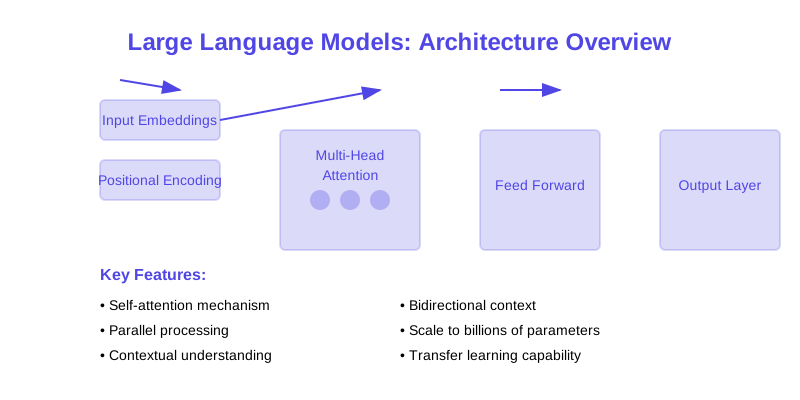
The Transformer's success is largely attributed to its self-attention mechanism, which allows the model to weigh the importance of different words in an input sequence when processing a particular word. Key components include:
- Self-Attention: Enables the model to attend to different positions of the input sequence to compute a representation of the sequence.
- Multi-Head Attention: Runs the self-attention mechanism multiple times in parallel with different learned linear projections of queries, keys, and values, allowing the model to jointly attend to information from different representation subspaces at different positions.
- Positional Encoding: Since Transformers do not inherently process sequences sequentially (unlike RNNs), positional encodings are added to input embeddings to inject information about the relative or absolute position of tokens in the sequence.
- Feed-Forward Networks: Applied independently to each position, these networks provide non-linearity.
- Layer Normalization: Applied before or after attention and feed-forward layers to stabilize training.
Training and Adaptation
LLMs undergo a multi-stage training process:
- Pre-training: This is the computationally intensive phase where a model learns general language understanding and generation abilities by predicting masked tokens or the next token in a sequence on a vast, diverse corpus (e.g., Common Crawl, Wikipedia, books).
- Fine-tuning: Adapting a pre-trained model to a specific downstream task or domain. This is typically done with a smaller, task-specific dataset. Techniques include:
- Full Fine-tuning: Updating all parameters of the pre-trained model.
- Parameter-Efficient Fine-Tuning (PEFT): Methods like LoRA (Low-Rank Adaptation) or adapters, which update only a small subset of parameters or add new, small trainable modules, significantly reducing computational cost and memory requirements.
Practical Implementation: Getting Started
1. Choosing Your LLM Framework and Access Method
Several frameworks and platforms provide access to LLMs:
-
Hugging Face Transformers: A widely adopted library offering a vast collection of pre-trained models, tokenizers, and training utilities. It's excellent for local experimentation and fine-tuning.
# Example: Text generation with Hugging Face Transformers from transformers import pipeline # Initialize a pipeline for text generation using a specific model # 'gpt2' is a foundational model; for more advanced tasks, consider larger models. generator = pipeline('text-generation', model='gpt2') prompt = "The increasing adoption of LLMs in software development suggests:" results = generator(prompt, max_length=100, num_return_sequences=1, truncation=True) print(results[0]['generated_text']) -
Cloud Provider APIs (OpenAI, Google Cloud Vertex AI, AWS Bedrock, Azure OpenAI): Offer managed access to state-of-the-art LLMs via APIs. This abstracts away infrastructure management but incurs usage costs.
# Conceptual example using a hypothetical API client # from some_llm_api import LLMClient # # client = LLMClient(api_key="YOUR_API_KEY") # # response = client.completions.create( # model="model-name-e.g.-gpt-4", # prompt="Explain the concept of emergent properties in LLMs:", # max_tokens=150 # ) # print(response.text) -
Frameworks for Local Deployment (e.g., Llama.cpp, Ollama): Allow running quantized LLMs efficiently on local hardware, including consumer-grade GPUs and even CPUs.
2. Mastering Prompt Engineering
The art of crafting effective prompts is critical for eliciting desired outputs from LLMs.
- Clarity and Specificity: Ambiguous prompts lead to ambiguous results. Define the task, desired output format, and any constraints clearly.
- Context Provision: Include relevant background information or examples to guide the model.
- Few-Shot Learning: Providing a few examples of input-output pairs within the prompt can significantly improve performance on tasks like classification or structured data extraction.
- Role-Playing: Instructing the model to act as a specific persona (e.g., "Act as a senior software engineer...") can prime it for a particular style or domain knowledge.
- Iterative Refinement: Prompt engineering is an iterative process. Test variations and analyze outputs to refine your prompts.
Example of Few-Shot Prompting:
Translate the following English sentences to French:

English: Hello, how are you?
French: Bonjour, comment allez-vous?

English: I need to book a flight.
French: Je dois réserver un vol.

English: What is the weather like today?
French: Quel temps fait-il aujourd'hui?

English: The system experienced an unexpected error.
French:
(The LLM is expected to complete the last line with "Le système a rencontré une erreur inattendue.")
3. Fine-tuning for Customization
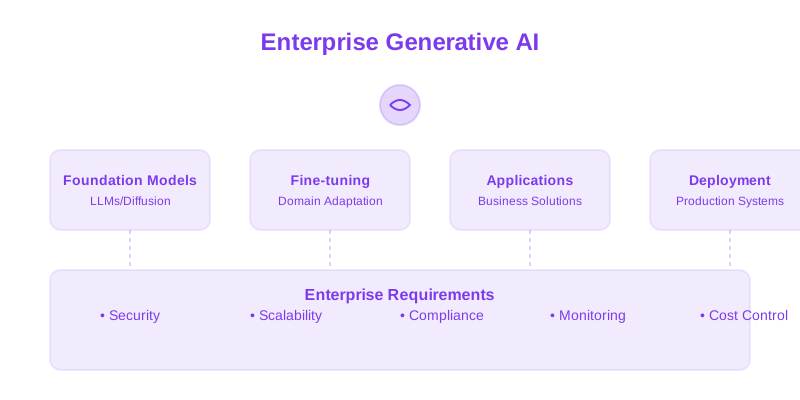
When general-purpose models don't meet specific domain requirements or performance targets, fine-tuning is necessary.
-
Data Preparation: Curate a high-quality, task-specific dataset. For supervised fine-tuning, this typically involves pairs of (input, desired output).
-
PEFT (Parameter-Efficient Fine-Tuning): For most custom LLM applications, PEFT methods like LoRA are preferred due to their significantly lower computational and memory footprint compared to full fine-tuning.
# Conceptual example using Hugging Face PEFT library (e.g., LoRA)
# This requires installing the 'peft' library.

# from transformers import AutoModelForCausalLM, AutoTokenizer
# from peft import LoraConfig, get_peft_model, TaskType
# import torch
#
# # Load a base model and tokenizer
# model_name = "gpt2"
# model = AutoModelForCausalLM.from_pretrained(model_name)
# tokenizer = AutoTokenizer.from_pretrained(model_name)
#
# # Define LoRA configuration
# lora_config = LoraConfig(
#     r=8,  # Rank of the update matrices
#     lora_alpha=16,  # Alpha parameter for LoRA scaling
#     target_modules=["q_proj", "v_proj"], # Modules to apply LoRA to
#     lora_dropout=0.05,
#     bias="none",
#     task_type=TaskType.CAUSAL_LM # For generative models
# )
#
# # Get the PEFT model
# peft_model = get_peft_model(model, lora_config)
# peft_model.print_trainable_parameters() # Shows a significantly reduced number of trainable parameters
#
# # Now you can use peft_model with a Trainer for fine-tuning
# # ... (Training setup as shown in the original article, but with peft_model)
Engineering Best Practices
1. Resource Management and Optimization
LLMs are resource-intensive. Efficient management is crucial for cost-effectiveness and performance.
- Quantization: Reducing the precision of model weights (e.g., from FP32 to INT8 or FP16) can significantly decrease memory footprint and inference latency with minimal accuracy loss. Libraries like and tools like
bitsandbytesorGPTQare common.AWQ - Batching: Processing multiple requests simultaneously (dynamic batching if requests arrive asynchronously) amortizes overhead and improves GPU utilization.
- Model Parallelism and Distributed Training/Inference: For very large models, distributing computation across multiple GPUs or machines is necessary. Frameworks like DeepSpeed and PyTorch FSDP offer solutions.
- Gradient Checkpointing: A memory-saving technique during training where intermediate activations are recomputed during the backward pass instead of being stored.
- Efficient Inference Engines: Libraries like TensorRT-LLM, vLLM, or ONNX Runtime can provide optimized kernels for faster inference.
2. Model Selection Strategy
Choosing the right model involves balancing capability with practical constraints.
- Task Suitability: Is the task general (e.g., broad text generation) or domain-specific (e.g., medical text analysis)? Smaller, fine-tuned models can outperform larger general models on niche tasks.
- Model Size vs. Performance vs. Cost: Larger models generally have better performance but require more compute for training and inference, leading to higher costs. Consider benchmark scores (e.g., MMLU, HELM) but validate with your specific use case.
- Latency Requirements: Real-time applications demand low-latency models, often necessitating smaller models, quantization, or specialized inference hardware/software.
- Open-Source vs. Proprietary: Open-source models (e.g., Llama, Mistral) offer flexibility and control, while proprietary models (e.g., GPT-4) might provide state-of-the-art performance without infrastructure headaches.
3. Ethical Considerations and Responsible AI
Deploying LLMs responsibly is paramount.
- Bias Mitigation: LLMs can inherit biases from their training data. Implement strategies for detecting and mitigating bias in model outputs, especially in sensitive applications.
- Data Privacy and Security: Ensure that sensitive data is not leaked through prompts or model outputs. Understand the data handling policies of third-party API providers.
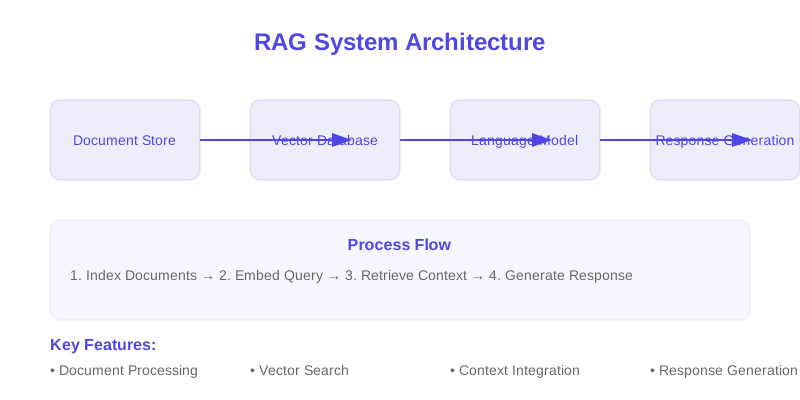
- Factuality and Hallucinations: LLMs can "hallucinate" plausible but incorrect information. Implement validation steps, provide grounding sources, or use retrieval-augmented generation (RAG) to improve factual accuracy.
- Transparency and Explainability: While LLMs are often black boxes, strive for transparency about their capabilities and limitations.
- Prompt Injection and Security: Guard against malicious prompts designed to hijack model behavior or extract sensitive information.
Common Engineering Applications
LLMs are versatile tools for various software engineering tasks:
- Code Generation & Assistance: Autocompletion, generating boilerplate code, translating between languages, writing unit tests.
- Automated Documentation: Generating API docs, code comments, or user guides from code.
- Natural Language Interfaces: Enabling users to interact with complex systems using natural language commands.
- Log Analysis and Debugging: Summarizing error logs, identifying patterns, suggesting potential fixes.
- Content Creation & Marketing: Generating marketing copy, product descriptions, or social media posts.
- Data Augmentation: Creating synthetic training data for other machine learning models.
- Sentiment Analysis & Content Moderation: Analyzing user feedback or moderating user-generated content.
Next Steps for Engineers
- Hands-on Experimentation: Utilize frameworks like Hugging Face to experiment with different models and fine-tuning techniques on your own datasets.
- Deep Dive into PEFT: Invest time in understanding methods like LoRA, QLoRA, and adapter-based tuning.
- Explore RAG (Retrieval-Augmented Generation): Integrate LLMs with external knowledge bases for more grounded and factual responses. This is often a more practical alternative to extensive fine-tuning for knowledge-intensive tasks.
- Benchmark and Validate: Don't rely solely on reported benchmarks. Evaluate model performance rigorously on your specific tasks and data.
- Stay Current: The LLM landscape evolves rapidly. Follow research papers, reputable AI blogs, and community discussions.
- Build Small Prototypes: Start with minimal viable products to understand the practical challenges and benefits of LLM integration.
Conclusion
Large Language Models offer transformative potential for engineering. By understanding their core principles, mastering practical implementation techniques, and adhering to robust engineering best practices and ethical guidelines, you can effectively harness their power to build innovative and valuable applications. The journey involves continuous learning and adaptation in this rapidly advancing field.
Resources
- Hugging Face Ecosystem:
- Cloud LLM Providers:
- Research and Trends:
- Efficient Inference:
When Not to Use LLMs
While powerful, LLMs are not a panacea. Consider alternatives when:
- Strict Determinism is Required: For systems where absolute, predictable, and deterministic outputs are critical (e.g., some financial calculations, safety-critical control systems), LLMs' probabilistic nature can be a liability.
- Computational Resources are Severely Limited: Running even moderately sized LLMs requires significant CPU/GPU and RAM. Simpler algorithms might suffice.
- Data is Highly Sensitive and Cannot Leave Local Environment: If using cloud APIs is not an option and local deployment of large models is infeasible, LLMs may not be suitable.
- Task is Simple and Well-Defined: For tasks that can be solved efficiently with traditional rule-based systems, regex, or simpler ML models (e.g., basic text classification with high confidence), the overhead of an LLM might be unwarranted.
- Real-time, Low-Latency Micro-interactions: While optimization is improving, achieving sub-100ms latency for complex LLM inference might still be challenging and costly compared to specialized models or deterministic logic.
- Cost is a Primary Constraint: API calls or the infrastructure for self-hosting can be expensive.
LLM Integration Decision Checklist
Before committing to an LLM-based solution, consider the following:
- [ ] Problem Definition: Is the problem fundamentally one of language understanding or generation?
- [ ] Data Availability: Do you have sufficient and appropriate data for fine-tuning or RAG?
- [ ] Performance Requirements: What are the acceptable latency, throughput, and accuracy levels?
- [ ] Resource Constraints: What are the available compute, memory, and budget limitations?
- [ ] Model Suitability: Has a suitable pre-trained model been identified? Is fine-tuning or RAG necessary?
- [ ] Ethical Implications: Have potential biases, privacy concerns, and safety risks been assessed?
- [ ] Deployment Strategy: Will you use cloud APIs, self-host open-source models, or a hybrid approach?
- [ ] Maintainability: How will prompts, fine-tuned models, and integrations be versioned and updated?
- [ ] Fallback Mechanisms: What happens if the LLM fails or produces unsatisfactory results?
- [ ] Cost-Benefit Analysis: Does the potential value of an LLM solution outweigh its implementation and operational costs?