AWS SNS Features: Building Scalable Pub/Sub Messaging Systems
Explore AWS Simple Notification Service (SNS) features and learn how to build scalable pub/sub messaging systems
Mastering AWS Simple Notification Service (SNS): A Deep Dive for Engineers
TL;DR: AWS SNS is a fully managed pub/sub messaging service ideal for decoupling applications and distributing notifications. This guide covers its core components, advanced features like filtering and FIFO topics, integration patterns, security, monitoring, and cost optimization, empowering engineers to leverage SNS effectively.
Introduction to AWS SNS
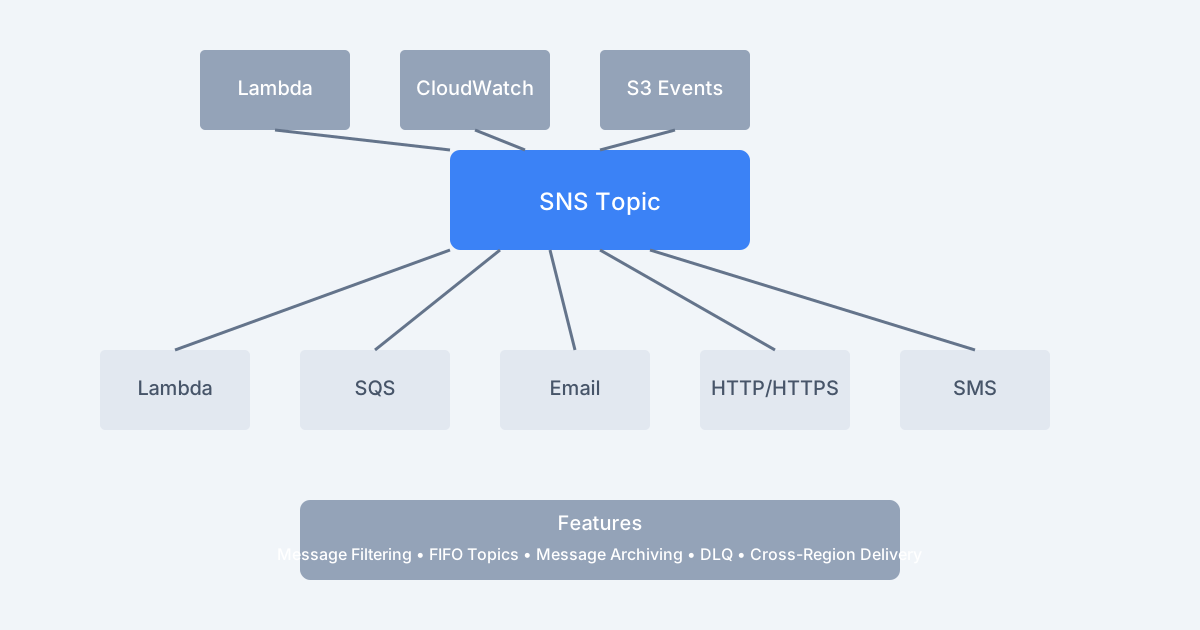
Amazon Simple Notification Service (SNS) is a fully managed, highly scalable, and reliable publish/subscribe messaging service. It enables you to decouple microservices, distributed systems, and serverless applications by facilitating asynchronous communication. Publishers send messages to SNS topics, and SNS delivers these messages to a fan-out of subscribers.
Key Components
- Topics: Logical access points for message publishers and subscribers. A topic is a communication channel.
- Publishers: Entities that send messages to SNS topics. These can be AWS services (e.g., CloudWatch, S3), custom applications, or other AWS resources.
- Subscribers: Endpoints that receive messages from SNS topics. SNS supports various protocols, including SQS, Lambda, HTTP/HTTPS, Email, SMS, and mobile push notifications.
Core SNS Features and Implementation
1. Creating and Managing SNS Topics
SNS offers two types of topics: Standard and FIFO. Standard topics provide high throughput and at-least-once delivery. FIFO (First-In, First-Out) topics ensure strict message ordering and exactly-once processing for compatible subscribers like SQS FIFO queues.
Creating a Standard Topic:
import boto3

sns_client = boto3.client('sns')

response = sns_client.create_topic(
    Name='my-application-events',
    Tags={
        'Environment': 'Production',
        'Project': 'FrontendService'
    }
)
standard_topic_arn = response['TopicArn']
print(f"Standard Topic ARN: {standard_topic_arn}")
Creating a FIFO Topic: FIFO topics require a
.fiforesponse_fifo = sns_client.create_topic( Name='my-order-processing.fifo', Attributes={ 'FifoTopic': 'true', 'ContentBasedDeduplication': 'true' # Or manage MessageDeduplicationId manually } ) fifo_topic_arn = response_fifo['TopicArn'] print(f"FIFO Topic ARN: {fifo_topic_arn}")
2. Managing Subscriptions
Subscribers can be attached to topics to receive messages. Each subscription can be configured with specific attributes, such as message filtering or delivery retry policies.
Subscribing an SQS Queue:
# Assuming 'my-app-queue' is an SQS queue ARN
sqs_queue_arn = 'arn:aws:sqs:us-east-1:123456789012:my-app-queue'
response = sns_client.subscribe(
    TopicArn=standard_topic_arn,
    Protocol='sqs',
    Endpoint=sqs_queue_arn
)
print(f"SQS Subscription ARN: {response['SubscriptionArn']}")
Subscribing a Lambda Function: Ensure the Lambda function's execution role has permissions to be invoked by SNS.
# Assuming 'my-processing-lambda' is a Lambda function ARN
lambda_function_arn = 'arn:aws:lambda:us-east-1:123456789012:function:my-processing-lambda'
response = sns_client.subscribe(
    TopicArn=standard_topic_arn,
    Protocol='lambda',
    Endpoint=lambda_function_arn
)
print(f"Lambda Subscription ARN: {response['SubscriptionArn']}")
Subscribing an HTTP/HTTPS Endpoint: SNS will send POST requests to the specified endpoint.
http_endpoint_url = 'https://api.example.com/notifications'
response = sns_client.subscribe(
    TopicArn=standard_topic_arn,
    Protocol='https',
    Endpoint=http_endpoint_url
)
print(f"HTTP Subscription ARN: {response['SubscriptionArn']}")
3. Publishing Messages
Publishers send messages to topics. Messages can contain a subject and a body. For more granular routing, message attributes can be included.
Publishing a Simple Message:
response = sns_client.publish(
    TopicArn=standard_topic_arn,
    Message='User signup complete.',
    Subject='New User Registration'
)
print(f"Message ID: {response['MessageId']}")
Publishing with Message Attributes: Message attributes are key-value pairs that can be used for filtering by subscribers.
response = sns_client.publish(
    TopicArn=standard_topic_arn,
    Message='Critical alert triggered.',
    Subject='System Alert',
    MessageAttributes={
        'Severity': {
            'DataType': 'String',
            'StringValue': 'Critical'
        },
        'Region': {
            'DataType': 'String',
            'StringValue': 'us-west-2'
        }
    }
)
print(f"Message ID with attributes: {response['MessageId']}")
Publishing to a FIFO Topic: FIFO topics require
MessageGroupIdMessageDeduplicationIdresponse = sns_client.publish( TopicArn=fifo_topic_arn, Message='Order details for batch processing.', MessageGroupId='batch-123', MessageDeduplicationId='order-abc-456' # Optional if ContentBasedDeduplication is true ) print(f"FIFO Message ID: {response['MessageId']}")
Advanced Features
1. Message Filtering
Message filtering allows subscribers to receive only messages that match specific criteria defined in a
FilterPolicyExample Filter Policy (JSON): This policy will only deliver messages with
Severity{ "Severity": ["Critical", "High"] }
Applying a Filter Policy to a Subscription:
# Subscribe an SQS queue with a filter policy
sqs_queue_filtered_arn = 'arn:aws:sqs:us-east-1:123456789012:my-filtered-queue'
filter_policy_json = json.dumps({
    "Severity": ["Critical", "High"],
    "Region": ["us-east-1"]
})

response = sns_client.subscribe(
    TopicArn=standard_topic_arn,
    Protocol='sqs',
    Endpoint=sqs_queue_filtered_arn,
    Attributes={
        'FilterPolicy': filter_policy_json
    }
)
print(f"Filtered SQS Subscription ARN: {response['SubscriptionArn']}")
2. Dead-Letter Queues (DLQs)
To handle undeliverable messages (e.g., endpoint unavailable, Lambda errors), configure a Dead-Letter Queue (DLQ). SNS will send messages that fail to deliver after a configured number of retries to this designated SQS queue.
Configuring a DLQ for an SQS Subscription:
# Assuming 'my-sns-dlq' is an SQS DLQ ARN
dlq_sqs_arn = 'arn:aws:sqs:us-east-1:123456789012:my-sns-dlq'
subscription_arn_to_configure = response['SubscriptionArn'] # From previous subscription step

sns_client.set_subscription_attributes(
    SubscriptionArn=subscription_arn_to_configure,
    AttributeName='RedrivePolicy',
    AttributeValue=json.dumps({
        'deadLetterTargetArn': dlq_sqs_arn
    })
)
print(f"DLQ configured for subscription: {subscription_arn_to_configure}")
3. FIFO Topics for Ordered Messaging
FIFO topics are crucial when message order is paramount, such as in financial transactions or state-change events. They guarantee that messages within the same
MessageGroupIdConsiderations for FIFO:
- Message Ordering: Guaranteed within a .
MessageGroupId - Deduplication: Use or provide a unique
ContentBasedDeduplication.MessageDeduplicationId - Subscribers: Only compatible with SQS FIFO queues and HTTP/S endpoints. Lambda integration with FIFO topics requires an SQS FIFO queue as an intermediary.
- Throughput: Standard topics offer higher throughput than FIFO topics.
4. Delivery Status Logging
SNS can log the delivery status of messages to CloudWatch Logs for specific endpoint types (SQS, Lambda, HTTP/S). This is invaluable for debugging delivery issues.
Enabling Delivery Status Logging:
sns_client.set_topic_attributes(
    TopicArn=standard_topic_arn,
    AttributeName='DeliveryStatusLogging',
    AttributeValue=json.dumps({
        'sqs': { 'Enabled': True, 'Level': 'ALL' },
        'lambda': { 'Enabled': True, 'Level': 'ALL' },
        'http': { 'Enabled': True, 'Level': 'ALL' }
    })
)
print(f"Delivery status logging enabled for topic: {standard_topic_arn}")
Integration Patterns
1. Integrating with AWS Services
SNS seamlessly integrates with many AWS services, enabling event-driven architectures.
CloudWatch Alarms: Trigger SNS notifications when an alarm state changes.
import boto3

cloudwatch_client = boto3.client('cloudwatch')

response = cloudwatch_client.put_metric_alarm(
    AlarmName='HighCPUUtilizationAlarm',
    ComparisonOperator='GreaterThanThreshold',
    EvaluationPeriods=5,
    MetricName='CPUUtilization',
    Namespace='AWS/EC2',
    Period=60,
    Statistic='Average',
    Threshold=80.0,
    ActionsEnabled=True,
    AlarmActions=[standard_topic_arn], # Publish to SNS topic on alarm
    AlarmDescription='Alarm when CPU exceeds 80%',
    Dimensions=[
        {'Name': 'InstanceId', 'Value': 'i-0123456789abcdef0'}
    ]
)
print("CloudWatch Alarm configured to publish to SNS.")
S3 Event Notifications: Notify SNS topics when S3 bucket events occur (e.g., object creation).
import boto3

s3_client = boto3.client('s3')

bucket_name = 'my-data-processing-bucket'

response = s3_client.put_bucket_notification_configuration(
    Bucket=bucket_name,
    NotificationConfiguration={
        'TopicConfigurations': [
            {
                'TopicArn': standard_topic_arn,
                'Events': ['s3:ObjectCreated:*'], # Trigger on any object creation
                'Filter': { # Optional: Filter events by prefix or suffix
                    'Key': {
                        'FilterRules': [
                            {'Name': 'prefix', 'Value': 'uploads/'},
                            {'Name': 'suffix', 'Value': '.csv'}
                        ]
                    }
                }
            }
        ]
    }
)
print(f"S3 event notifications configured for bucket '{bucket_name}'.")
2. Cross-Account Access
Allow publishers in one AWS account to send messages to topics in another account. This requires a resource-based policy on the SNS topic.
SNS Topic Policy for Cross-Account Publishing:
{
    "Version": "2012-10-17",
    "Statement": [
        {
            "Effect": "Allow",
            "Principal": {
                "AWS": "arn:aws:iam::PUBLISHER_ACCOUNT_ID:root"
            },
            "Action": "sns:Publish",
            "Resource": "arn:aws:sns:REGION:SUBSCRIBER_ACCOUNT_ID:YOUR_TOPIC_NAME"
        }
    ]
}
Replace PUBLISHER_ACCOUNT_IDSUBSCRIBER_ACCOUNT_IDREGIONYOUR_TOPIC_NAME
3. Fan-out Pattern
SNS is inherently designed for the fan-out pattern, where a single message published to a topic is delivered to multiple different types of subscribers simultaneously. This is fundamental for event-driven architectures.
Monitoring and Logging
Effective monitoring is crucial for ensuring the health and performance of your SNS-based systems.
1. CloudWatch Metrics
SNS publishes metrics to CloudWatch, providing insights into publish/subscribe activity, delivery status, and errors. Key metrics include:
- : Number of messages published to the topic.
NumberOfMessagesPublished - : Number of messages successfully delivered to subscribers.
NumberOfNotificationsDelivered - : Number of messages that failed to deliver.
NumberOfNotificationsFailed - : Size of messages published.
PublishSize
Example: Fetching NumberOfMessagesPublished
import boto3
from datetime import datetime, timedelta, timezone

cloudwatch_client = boto3.client('cloudwatch')
topic_name = 'my-application-events'
region = 'us-east-1' # Specify your topic's region

# Calculate start and end times for the last hour
end_time = datetime.now(timezone.utc)
start_time = end_time - timedelta(hours=1)

response = cloudwatch_client.get_metric_statistics(
    Namespace='AWS/SNS',
    MetricName='NumberOfMessagesPublished',
    Dimensions=[
        {
            'Name': 'TopicName',
            'Value': topic_name
        }
    ],
    StartTime=start_time,
    EndTime=end_time,
    Period=300, # 5-minute intervals
    Statistics=['Sum']
)
print(f"SNS Publish Metrics for {topic_name}: {response['Datapoints']}")
2. CloudWatch Logs
As mentioned in "Delivery Status Logging," detailed delivery logs can be sent to CloudWatch Logs, allowing for granular analysis of delivery success and failure reasons for specific subscribers.
Security Best Practices
1. Access Control Policies
Use IAM policies and topic resource-based policies to control who can publish to or subscribe from your SNS topics.
Example: Topic Policy to allow publishing from a specific AWS service (e.g., EventBridge Rules):
{
    "Version": "2012-10-17",
    "Statement": [
        {
            "Effect": "Allow",
            "Principal": {
                "Service": "events.amazonaws.com"
            },
            "Action": "sns:Publish",
            "Resource": "arn:aws:sns:REGION:ACCOUNT_ID:YOUR_TOPIC_NAME",
            "Condition": {
                "ArnLike": {
                    "aws:SourceArn": "arn:aws:events:REGION:ACCOUNT_ID:rule/YOUR_RULE_NAME"
                }
            }
        }
    ]
}
2. Encryption
- Server-Side Encryption (SSE): Encrypt messages at rest using AWS KMS.
- HTTPS for Transport: Always use HTTPS for subscriptions to ensure messages are encrypted in transit.
Enabling SSE for an SNS Topic:
# Using a customer-managed KMS key
kms_key_arn = 'arn:aws:kms:us-east-1:123456789012:key/abcdef01-2345-6789-abcd-ef0123456789'

response = sns_client.set_topic_attributes(
    TopicArn=standard_topic_arn,
    AttributeName='KmsMasterKeyId',
    AttributeValue=kms_key_arn
)
print(f"SSE enabled for topic {standard_topic_arn} using KMS key {kms_key_arn}.")
Cost Optimization
1. Message Filtering
Implement precise filter policies to ensure messages are only delivered to relevant subscribers. This prevents unnecessary invocations and processing, directly reducing costs.
2. DLQ Management
Regularly review and purge messages from Dead-Letter Queues. Accumulating messages in a DLQ incurs SQS storage costs and indicates persistent delivery issues that need resolution.
3. Batching (for Publishers)
While SNS itself doesn't offer a direct batch publish API for standard topics (each
publish- Lambda Publisher Functions: If publishing from Lambda, use its concurrency and efficient SDK calls.
- SQS to SNS: For very high volumes, a common pattern is SQS -> Lambda -> SNS. The Lambda can batch messages from SQS before publishing to SNS, although this adds complexity.
Note: Batching is more relevant when consuming messages from SNS into SQS, or when publishing to SQS directly. For SNS publish, the primary optimization is efficient publishing code and correct filtering.
4. Topic Types
Understand that FIFO topics have different pricing and throughput limits compared to Standard topics. Use FIFO only when strictly necessary for ordering guarantees.
Trade-offs and Considerations
| Feature/Aspect | Standard Topics | FIFO Topics | Trade-offs | | :------------------------ | :-------------------------------------------------- | :----------------------------------------------------- | :-------------------------------------------------------------------------------------------------------------- | | Message Ordering | At-least-once, best-effort ordering | Exactly-once processing, strict ordering per
MessageGroupIdMessageDeduplicationIdWhen Not to Use SNS
- Synchronous Request/Response: SNS is asynchronous. For immediate, synchronous communication, consider API Gateway, direct Lambda invocations, or ECS/EKS service communication.
- Guaranteed Message Delivery to ALL Subscribers: While SNS is highly available, it doesn't guarantee every subscriber will receive every message if the subscriber endpoint is persistently unavailable and no DLQ is configured. SQS with its own retry mechanisms and DLQs offers stronger guarantees for individual message processing.
- Complex Message Routing (beyond attributes): For complex routing logic based on message content, a Lambda function acting as a router after receiving from SNS might be necessary, or consider a dedicated message broker.
- High-Volume, Low-Latency Ordered Message Queuing (for a single consumer): For scenarios requiring extremely high throughput and strict ordering with a single consumer, SQS FIFO queues might be a more direct fit than SNS FIFO topics feeding SQS FIFO queues.
Decision Checklist
Use this checklist to determine if SNS is the right choice for your use case:
- Asynchronous Communication Required?
- [ ] Yes
- [ ] No (Consider synchronous alternatives)
- Decoupling Services Needed?
- [ ] Yes
- [ ] No
- Fan-out Notification Pattern Required (One message to many)?
- [ ] Yes
- [ ] No (Consider direct calls or SQS for one-to-one)
- Message Order Critical?
- [ ] Yes (Consider SNS FIFO topics)
- [ ] No (Standard topics are generally sufficient and higher throughput)
- Exactly-Once Processing Required (for ordered messages)?
- [ ] Yes (SNS FIFO + SQS FIFO is a strong candidate)
- [ ] No
- Need to integrate with AWS services like CloudWatch or S3 for notifications?
- [ ] Yes
- [ ] No
- Are subscribers primarily external HTTP/S endpoints, Lambda functions, or SQS queues?
- [ ] Yes (SNS supports these well)
- [ ] No (Investigate alternative protocols/services)
- Is simple, managed pub/sub a primary requirement?
- [ ] Yes
- [ ] No (Consider self-managed Kafka or RabbitMQ if more control is needed)
If you answered "Yes" to questions 1, 2, and 3, SNS is likely a good fit. Further answers will guide you towards Standard or FIFO topics and specific integration patterns.
Conclusion
AWS SNS is a powerful and flexible service for building event-driven architectures. By understanding its core features—topics, publishers, subscribers—and advanced capabilities like message filtering, FIFO topics, and dead-letter queues, engineers can effectively decouple their applications, distribute notifications, and enhance system resilience. Proper implementation of security best practices, monitoring, and cost optimization ensures a robust and efficient messaging solution.
Further Exploration
- Advanced Filtering: Explore complex filter policies including wildcard and existence matching.
- Cross-Region Replication: For disaster recovery or global applications, investigate SNS cross-region replication.
- Message Transformation: For integrations requiring message format changes, consider using Lambda functions between SNS and the final subscriber.
- Monitoring Dashboards: Create custom CloudWatch dashboards to visualize key SNS metrics.
- Automated Topic/Subscription Management: Use AWS CloudFormation or Terraform to provision and manage SNS resources.