gcp
GCP Data Analytics Services: Building Modern Data Platforms
Master Google Cloud's data analytics services. Learn about BigQuery, Dataflow, Pub/Sub, Dataproc, and best practices for building scalable data analytics solutions.
March 1, 2024
cleartechy editorial team
6 min read
GCP Data Analytics Services: Building Modern Data Platforms
Google Cloud Platform provides a comprehensive suite of services for building modern data analytics solutions. This guide covers key services and implementation best practices.
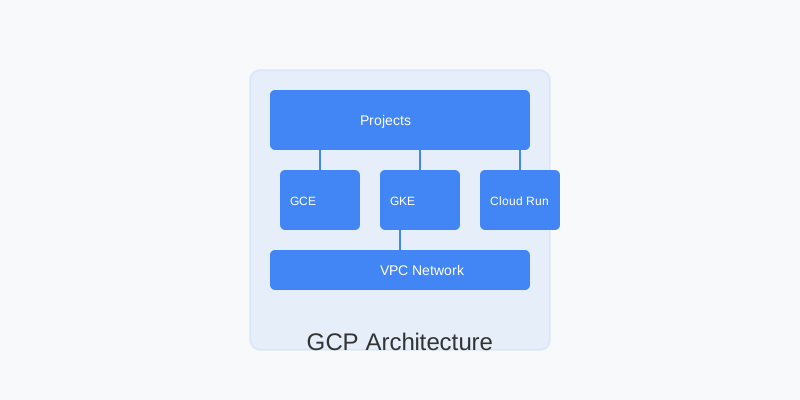
Analytics Architecture Overview
Flowchart Diagram
Rendering diagram...
BigQuery
1. Dataset and Table Creation
-- Create dataset
CREATE SCHEMA IF NOT EXISTS my_dataset
OPTIONS(
  location="US",
  default_partition_expiration_days=90,
  description="Analytics dataset"
);

-- Create partitioned and clustered table
CREATE OR REPLACE TABLE my_dataset.events
(
  event_id STRING,
  user_id STRING,
  event_timestamp TIMESTAMP,
  event_type STRING,
  device STRING,
  location STRING,
  properties JSON
)
PARTITION BY DATE(event_timestamp)
CLUSTER BY user_id, event_type
OPTIONS(
  require_partition_filter=true,
  partition_expiration_days=90,
  description="Event tracking table"
);
2. Query Optimization
-- Efficient query with partition filter
WITH UserEvents AS (
  SELECT
    user_id,
    event_type,
    COUNT(*) as event_count,
    MIN(event_timestamp) as first_event,
    MAX(event_timestamp) as last_event
  FROM my_dataset.events
  WHERE DATE(event_timestamp) BETWEEN DATE_SUB(CURRENT_DATE(), INTERVAL 30 DAY)
    AND CURRENT_DATE()
  GROUP BY user_id, event_type
)

SELECT
  user_id,
  ARRAY_AGG(STRUCT(
    event_type,
    event_count,
    first_event,
    last_event
  )) as event_details,
  SUM(event_count) as total_events
FROM UserEvents
GROUP BY user_id
HAVING total_events > 100
ORDER BY total_events DESC
LIMIT 1000;
Dataflow
1. Batch Processing Pipeline
# batch_pipeline.py
import apache_beam as beam
from apache_beam.options.pipeline_options import PipelineOptions

def parse_event(element):
    """Parse event data."""
    import json
    event = json.loads(element)
    return {
        'event_id': event['id'],
        'user_id': event['user_id'],
        'timestamp': event['timestamp'],
        'event_type': event['type'],
        'properties': event.get('properties', {})
    }

def run_pipeline():
    """Execute batch processing pipeline."""
    options = PipelineOptions()

    with beam.Pipeline(options=options) as p:
        events = (
            p
            | 'ReadFromGCS' >> beam.io.ReadFromText('gs://my-bucket/events/*.json')
            | 'ParseJSON' >> beam.Map(parse_event)
            | 'AddTimestamp' >> beam.Map(
                lambda x: beam.window.TimestampedValue(x, x['timestamp']))
            | 'WindowEvents' >> beam.WindowInto(
                beam.window.FixedWindows(60 * 60))  # 1-hour windows
            | 'CountByType' >> beam.CombinePerKey(sum)
            | 'WriteToBigQuery' >> beam.io.WriteToBigQuery(
                'project:dataset.table',
                schema='event_type:STRING,count:INTEGER',
                write_disposition=beam.io.BigQueryDisposition.WRITE_APPEND,
                create_disposition=beam.io.BigQueryDisposition.CREATE_NEVER)
        )
2. Streaming Pipeline
# streaming_pipeline.py
def run_streaming():
    """Execute streaming pipeline."""
    options = PipelineOptions()
    options.view_as(StandardOptions).streaming = True

    with beam.Pipeline(options=options) as p:
        events = (
            p
            | 'ReadFromPubSub' >> beam.io.ReadFromPubSub(
                subscription='projects/my-project/subscriptions/my-subscription')
            | 'ParseJSON' >> beam.Map(parse_event)
            | 'AddEventTimestamp' >> beam.Map(
                lambda x: beam.window.TimestampedValue(x, x['timestamp']))
            | 'WindowEvents' >> beam.WindowInto(
                beam.window.SlidingWindows(
                    size=60 * 60,  # 1-hour windows
                    period=60))    # Sliding every minute
            | 'ProcessEvents' >> beam.ParDo(ProcessEvents())
            | 'WriteToBigQuery' >> beam.io.WriteToBigQuery(
                'project:dataset.table',
                schema='event_type:STRING,count:INTEGER,window_start:TIMESTAMP',
                write_disposition=beam.io.BigQueryDisposition.WRITE_APPEND,
                create_disposition=beam.io.BigQueryDisposition.CREATE_NEVER)
        )
Pub/Sub
1. Topic and Subscription Setup
# Create topic
gcloud pubsub topics create my-topic

# Create subscription
gcloud pubsub subscriptions create my-subscription \
  --topic=my-topic \
  --ack-deadline=30 \
  --message-retention-duration=7d \
  --expiration-period=never
2. Message Publishing
# publisher.py
from google.cloud import pubsub_v1
import json
import time

def publish_messages(project_id, topic_id):
    """Publish messages to Pub/Sub topic."""
    publisher = pubsub_v1.PublisherClient()
    topic_path = publisher.topic_path(project_id, topic_id)

    def get_callback(future, data):
        def callback(future):
            try:
                print(f"Published message ID: {future.result()}")
            except Exception as e:
                print(f"Error publishing {data}: {e}")
        return callback

    for i in range(100):
        data = {
            'message_id': i,
            'timestamp': time.time(),
            'data': f"Message {i}"
        }
        data_str = json.dumps(data)
        future = publisher.publish(
            topic_path,
            data_str.encode('utf-8'),
            origin="python-sample",
            username="gcp-user"
        )
        future.add_done_callback(get_callback(future, data))
Dataproc
1. Cluster Configuration
# cluster-config.yaml
config:
  gceClusterConfig:
    zoneUri: us-central1-a
    subnetworkUri: projects/my-project/regions/us-central1/subnetworks/my-subnet
    internalIpOnly: true
  masterConfig:
    numInstances: 1
    machineTypeUri: n1-standard-4
    diskConfig:
      bootDiskSizeGb: 100
      numLocalSsds: 1
  workerConfig:
    numInstances: 2
    machineTypeUri: n1-standard-4
    diskConfig:
      bootDiskSizeGb: 100
      numLocalSsds: 1
  softwareConfig:
    imageVersion: 2.0
    optionalComponents:
      - JUPYTER
      - ZEPPELIN
2. Spark Job Submission
# spark_job.py
from pyspark.sql import SparkSession
from pyspark.sql.functions import *

def process_data():
    """Process data using Spark."""
    spark = SparkSession.builder \
        .appName("DataProcessing") \
        .getOrCreate()

    # Read data
    df = spark.read.parquet("gs://my-bucket/data/*.parquet")

    # Process data
    result = df.groupBy("category") \
        .agg(
            count("*").alias("total_count"),
            sum("amount").alias("total_amount"),
            avg("amount").alias("avg_amount")
        )

    # Write results
    result.write \
        .mode("overwrite") \
        .format("bigquery") \
        .option("table", "project.dataset.results") \
        .save()
Data Visualization
1. Looker Studio Dashboard
-- Create view for dashboard
CREATE OR REPLACE VIEW my_dataset.dashboard_data AS
SELECT
  DATE(event_timestamp) as event_date,
  event_type,
  device,
  location,
  COUNT(*) as event_count,
  COUNT(DISTINCT user_id) as unique_users
FROM my_dataset.events
WHERE DATE(event_timestamp) >= DATE_SUB(CURRENT_DATE(), INTERVAL 90 DAY)
GROUP BY event_date, event_type, device, location;
2. Custom Visualization
// visualization.js
const drawChart = (data) => {
  const config = {
    type: 'line',
    data: {
      labels: data.map(d => d.date),
      datasets: [{
        label: 'Event Count',
        data: data.map(d => d.count),
        borderColor: '#4285f4',
        tension: 0.1
      }]
    },
    options: {
      responsive: true,
      scales: {
        y: {
          beginAtZero: true
        }
      }
    }
  };

  const ctx = document.getElementById('myChart').getContext('2d');
  new Chart(ctx, config);
};
Performance Optimization
1. BigQuery Optimization
-- Optimize table partitioning
ALTER TABLE my_dataset.events
SET OPTIONS (
  require_partition_filter=true,
  partition_expiration_days=90
);

-- Create materialized view
CREATE MATERIALIZED VIEW my_dataset.daily_metrics
AS SELECT
  DATE(event_timestamp) as event_date,
  event_type,
  COUNT(*) as event_count,
  COUNT(DISTINCT user_id) as unique_users
FROM my_dataset.events
GROUP BY event_date, event_type;
2. Pipeline Optimization
# pipeline_optimization.py
def optimize_pipeline(p):
    """Optimize Dataflow pipeline."""
    return (p
        | 'ReadData' >> beam.io.ReadFromSource(...)
        | 'Reshuffle' >> beam.Reshuffle()  # Optimize data distribution
        | 'Transform' >> beam.ParDo(...)
        .with_output_types(...)  # Add type hints
        | 'Combine' >> beam.CombinePerKey(
            combine_fn=MyCombineFn(),
            fanout=4)  # Optimize combine operation
        | 'Write' >> beam.io.WriteToBigQuery(...)
    )
Cost Optimization
-
BigQuery Optimization
- Use partitioning effectively
- Implement clustering
- Optimize query patterns
- Use materialized views
-
Pipeline Optimization
- Right-size workers
- Use appropriate machine types
- Optimize data flow
- Implement caching
-
Storage Optimization
- Use appropriate storage classes
- Implement lifecycle policies
- Compress data effectively
- Clean up temporary data
Best Practices
-
Data Management
- Implement data governance
- Use proper schemas
- Regular data cleanup
- Version control
-
Security
- Implement proper IAM
- Encrypt sensitive data
- Monitor access patterns
- Regular security reviews
-
Performance
- Monitor resource usage
- Optimize queries
- Regular maintenance
- Scale appropriately
Conclusion
GCP provides powerful services for building data analytics solutions. Key takeaways:
- Choose appropriate services
- Optimize performance
- Implement security
- Monitor costs
- Follow best practices
For more information, refer to the official documentation:
gcp
data-analytics
bigquery
dataflow
data-processing